Alright, let’s cut to the chase. You’re thinking about becoming a Certified Home Health Aide (CHHA), right? Good move. Seriously. It’s more than just a job; it’s a calling, a real way to make a difference in someone’s life when they need it most. But how do you actually get there? It’s not exactly a walk in the park, but it’s definitely achievable. We’re talking about getting the official stamp of approval, the certification that says you know your stuff and you’re ready to provide compassionate care.
Forget those sterile, jargon-filled guides. This is the real deal, the unvarnished truth about what it takes. We’ll break it all down, from the initial spark of interest to holding that hard-earned certificate in your hand. Think of it as your roadmap, designed by someone who’s been in the trenches, who gets the challenges and, more importantly, the incredible rewards.
So, What Exactly IS a CHHA?
First things first, let’s define our terms. What does a Certified Home Health Aide actually do? It’s not just about handing out pills or changing bedpans, though those are part of it. A CHHA is a Key link in the healthcare chain. You’re often the primary point of contact for patients in their own homes, offering not just physical assistance but also emotional support. These folks are often seniors or individuals with chronic illnesses, and your presence can be the highlight of their day. It’s a personal touch that makes a huge difference.
The Daily Grind: What to Expect
This: You walk into a client’s home. The air might smell faintly of lavender or maybe toast. Your client, let’s call her Mrs. Gable, is waiting. She might need help getting out of bed, preparing a meal, or taking her medication. You’re not just a caregiver; you’re a companion, a listener, a source of comfort. You help with personal hygiene, light housekeeping, and sometimes even errands.
It’s hands-on work, no doubt about it. You’ll be assisting with mobility, ensuring they’re safe and comfortable. This could involve transferring them from a chair to their bed or helping them navigate their home. The goal is always to promote independence while providing necessary support. You’re there to Enable them, not to do everything for them, though sometimes that line can feel blurry.
Beyond the Basics: Needed Skills
Sure, you’ll learn the technical skills in training. But being a great CHHA goes deeper. You need to be incredibly patient. Some days will test that patience to its absolute limit. Empathy is non-negotiable; you have to be able to put yourself in your client’s shoes, understanding their fears, frustrations, and limitations. Good communication is also key. You need to listen actively, not just to what they say, but what they don’t say. And let’s not forget about reliability. Your clients depend on you. Being punctual and dependable builds trust, and trust is everything in this field.
Is This Career Path Right For You?
Now, be honest with yourself. Are you comfortable with personal care tasks? Can you handle the emotional ups and downs that come with caring for vulnerable individuals? Do you genuinely feel a pull to help people in their time of need? If you’re nodding along, then yes, this could absolutely be your calling. It’s demanding, but the fulfillment you get from truly helping someone is Best. It’s a rewarding career choice for the right person.
The Nitty-Gritty: CHHA Requirements
Source : tshc.com
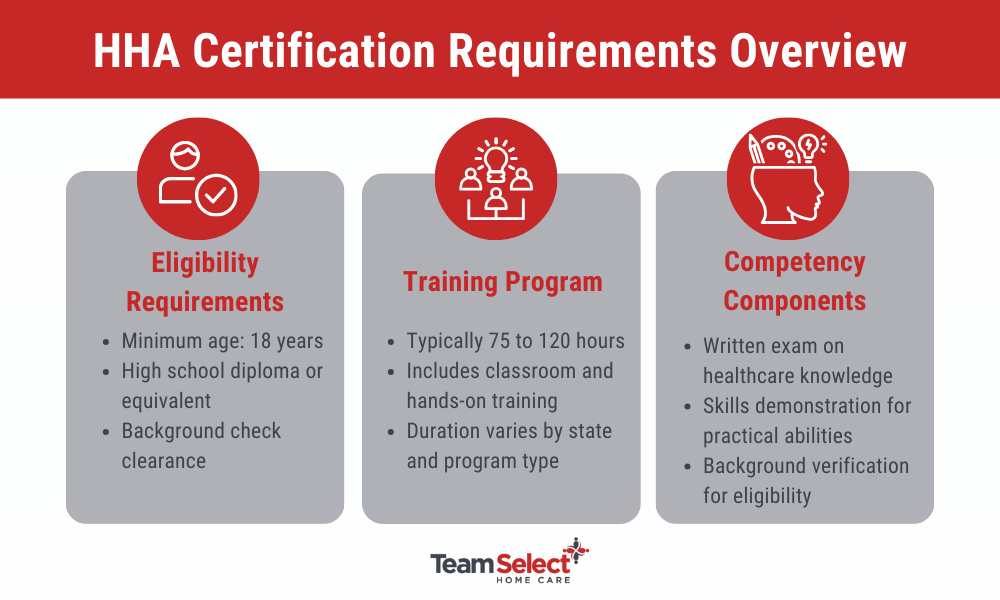
Okay, so you’re sold on the idea. Now, what are the hoops you actually have to jump through? It’s not as simple as just deciding you want to be a CHHA. There are specific criteria you’ll need to meet, and they vary slightly by state, but the core elements are pretty consistent. Think of these as your prerequisites for entry into this Needed profession.
Age and Education Minimums
Most states require you to be at least 18 years old. Seems obvious, right? But it’s a hard line. You also typically need a high school diploma or a GED. They want to know you have a basic level of education to grasp the training material. It’s not rocket science, but you need to be able to read, write, and understand instructions effectively. This forms the foundation for all the specialized knowledge you’ll gain.
Background Checks: The Necessary Evil
This one is a biggie. Because you’ll be working with vulnerable populations, usually in their homes, a thorough background check is standard procedure. They’re looking for criminal convictions, especially anything related to abuse, neglect, or theft. It’s for the safety of the clients. They need to trust the person entering their sanctuary. Don’t sweat it if you had a minor infraction years ago, but serious offenses will likely be a roadblock. It’s a Key screening process.
Health Requirements: Staying Fit for Duty
You can’t care for others if you’re not well yourself. So, expect to undergo a health screening. This usually includes a physical exam, TB test, and possibly a drug screening. They want to Make sure you’re physically capable of performing the duties of a CHHA and that you aren’t carrying any contagious diseases that could put clients at risk. It’s about ensuring a safe and healthy environment for everyone involved.
Handling the Training and Certification Maze

Source : contactcenterpipeline.com
This is where the real work begins. Becoming a CHHA isn’t just about meeting basic requirements; it’s about acquiring the knowledge and skills through approved training programs. These programs are designed to equip you with everything you need to know to excel in your role. It’s a structured pathway to competence.
Finding an Approved Training Program
Not just any class will do. You need to find a program that’s specifically approved by your state’s Department of Health or equivalent agency. These programs vary in length and format, but they all cover a core curriculum. Think classroom learning, hands-on skills practice, and supervised clinical experience. You can usually find a list of approved programs on your state’s government website. For example, in New Jersey, you can find information about these programs, though always verify directly with the state for the most current listings. It’s Key to attend a reputable training provider.
The Curriculum: What You’ll Learn
Get ready to learn a lot! The curriculum typically covers Key topics like basic nursing skills, personal care, infection control, safety procedures, nutrition, anatomy and physiology, and recognizing changes in a patient’s condition. You’ll also Look into communication and interpersonal skills, understanding the emotional and psychological needs of patients, and ethical responsibilities. It’s a Full overview designed to make you a well-rounded caregiver. You’ll learn how to take Key signs, assist with ambulation, and even perform basic first aid.
The Supervised Clinical Experience
This is where theory meets practice. A significant portion of your training will involve hands-on experience in a supervised setting, often a healthcare facility or even in clients’ homes under direct observation. This is your chance to apply what you’ve learned in a real-world environment. You’ll work directly with patients, performing tasks under the watchful eye of an instructor. This practical training is Crucial for building confidence and proficiency.
Passing the Certification Exam
Once you’ve completed your training program, the final hurdle is the certification exam. This is usually administered by the state or a designated testing agency. It typically consists of two parts: a written or computerized knowledge test and a practical skills assessment. You’ll need to demonstrate both your understanding of the material and your ability to perform Needed tasks correctly. Passing this exam is your ticket to becoming a credentialed CHHA. It’s the culmination of all your hard work and a key step to employment.
The CHHA Certification: What It Means
Source : stjudenursingschool.com
So, you’ve slogged through the training, aced the exam. What now? That certification is more than just a piece of paper. It’s your professional credential, your entry pass into a fulfilling career. It signifies that you’ve met the state’s standards and are deemed competent to provide care. It’s a badge of honor, really.
Why Certification Matters
Honestly, certification is non-negotiable in most places. It tells employers and clients that you’ve been vetted and trained. Without it, you’re generally not allowed to work as a home health aide. It protects the public by ensuring a minimum standard of care. Think of it like a driver’s license for the healthcare world. You wouldn’t want someone driving you around who hasn’t proven they can handle the wheel, right? This is the same idea, just for caring for people.
Understanding State Variations
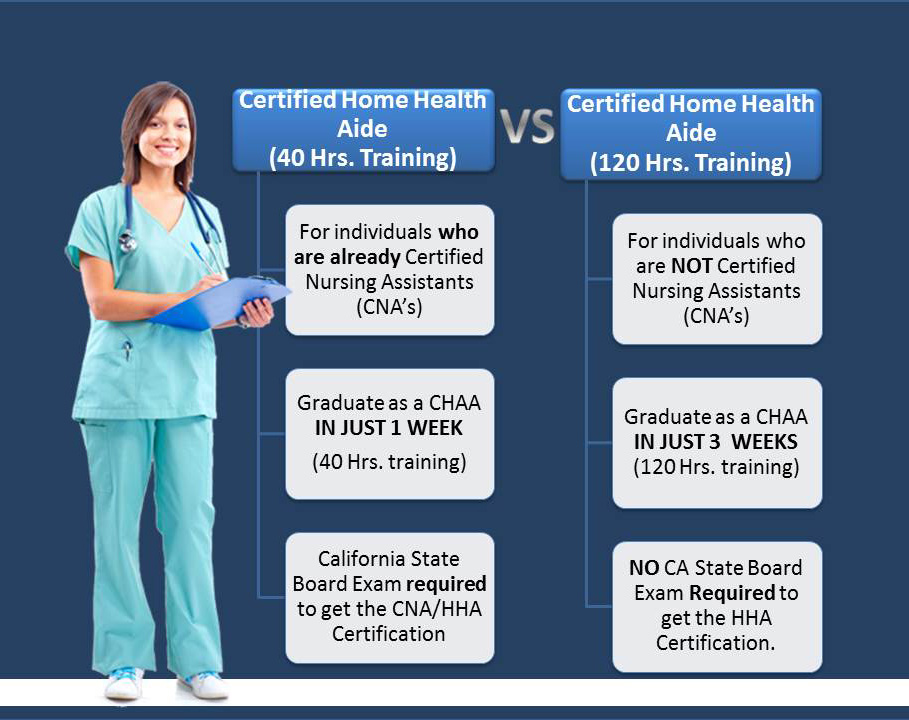
While the core concept is the same, remember that specific requirements can differ significantly from one state to another. Training hours, exam formats, and renewal processes all have their own unique flavor. What’s valid in California might not be exactly the same in Florida. It’s Key to research the specific regulations for the state where you intend to work. Don’t assume; always verify. This is where you’ll find out about state-specific requirements and approved training programs, like those outlined by the New Jersey Department of Human Services.
Maintaining Your Certification
Getting certified is a huge accomplishment, but it’s not a “set it and forget it” kind of deal. Most states require you to renew your CHHA certification periodically, usually every two years. This renewal process typically involves completing a certain number of continuing education hours to Make sure you stay up-to-date with the latest practices and information in the field. It keeps your skills sharp and ensures you’re providing the best possible care. It’s a commitment to ongoing professional development.
Beyond Certification: Building Your Career
Source : pe.gatech.edu
Having your CHHA certification is the Needed first step, but it’s just the beginning. The world of healthcare is vast, and your journey as a home health aide can lead in many directions. Think of this certification as your launching pad.
Finding Your First CHHA Job
With your certification in hand, you’re ready to start applying for positions. Many home health agencies actively recruit newly certified aides. You can also look at hospitals, nursing homes, and even private individuals seeking in-home care. Networking within your training program can also open doors. Don’t be afraid to start with a position that might not seem perfect; gaining experience is key. A solid resume is Needed.
Watch: HHA Certification Explained: Become A Certified Home Health …
Career Advancement Opportunities
Where can a CHHA go from here? Plenty of places! Many aides use their experience to move into supervisory roles, train new aides, or pursue further education to become Licensed Practical Nurses (LPNs) or Registered Nurses (RNs). Some specialize in specific areas like dementia care or hospice. The skills you gain as a CHHA are transferable and highly valued across the healthcare spectrum. Your initial certification is a stepping stone, not a ceiling.
The Importance of Soft Skills
We’ve touched on this, but it bears repeating. Technical skills will get you through the training, but soft skills will make you Key. Your ability to connect with clients, manage difficult situations with grace, and work effectively as part of a care team is what truly sets a great CHHA apart. Employers look for candidates who are not just skilled but also compassionate and reliable. Excellent communication is Key for success.
| Aspect | Description | Typical Requirement | Why It Matters |
|---|---|---|---|
| Age | Minimum age to legally work as a healthcare provider. | 18 years old | Ensures legal working capacity and maturity. |
| Education | Basic academic qualification for understanding training. | High School Diploma or GED | Foundation for learning complex healthcare concepts. |
| Background Check | Screening for criminal history. | Clean criminal record (especially regarding vulnerable persons) | Client safety and trust. |
| Health Screening | Assessment of physical ability and health status. | Physical exam, TB test, possibly drug screen | Ability to perform duties safely and prevent disease spread. |
| Training Program | State-approved curriculum covering Needed skills. | Completion of a set number of hours (e.g., 75-120+) | Acquiring necessary knowledge and practical skills. |
| Certification Exam | State or agency-administered test. | Passing score on written and practical portions | Official credentialing of competence. |
Alright, so you’re looking to dive deeper into this whole HHA thing, huh? Good. Because honestly, just scratching the surface isn’t going to cut it. We need to get our hands dirty with the nitty-gritty details. This ain’t your grandma’s encyclopedia entry; we’re talking real talk here, the stuff that actually matters when you’re trying to make a career change or just get your foot in the door of healthcare.
How To Get Hha Certification Online For Free
Source : homehealthaideguide.com
Handling the Free Online Field
Let’s be real, “free” and “certification” can sometimes feel like a mythical creature. But it’s not entirely a fairy tale. You’ll find programs offering free HHA certification online, often through government initiatives or non-profit organizations. These are goldmines, but you gotta be sharp. They’re usually first-come, first-served, and the spots fill up faster than free donuts at a union meeting.
The Catch with “Free” Programs
Here’s the kicker: even “free” training might have hidden costs. Think background checks, required textbooks, or exam fees. So, when you’re scouting for these freebies, read the fine print like a hawk. Is it truly zero out-of-pocket? Or are there some incidental expenses lurking around the corner?
Scouring for Reputable Free Courses
Where do you even start looking? Good question. Department of Labor websites, local community colleges, and even some large healthcare organizations sometimes offer sponsored training. Don’t just click the first link you see. Do your homework. Make sure the program is accredited and recognized by your state’s board of nursing or health department. A free certificate that’s worthless is just a waste of your time, plain and simple.
Alternative Pathways to Reduced Costs
If truly free isn’t panning out, look for programs with scholarships or grants. Some employers might even sponsor your training in exchange for a commitment to work for them. It’s a trade-off, sure, but it beats shelling out hundreds, if not thousands, of dollars upfront.
What Are The Requirements To Become A Certified Home Health Aide
Source : homehealthaideguide.com
The Baseline Eligibility Criteria
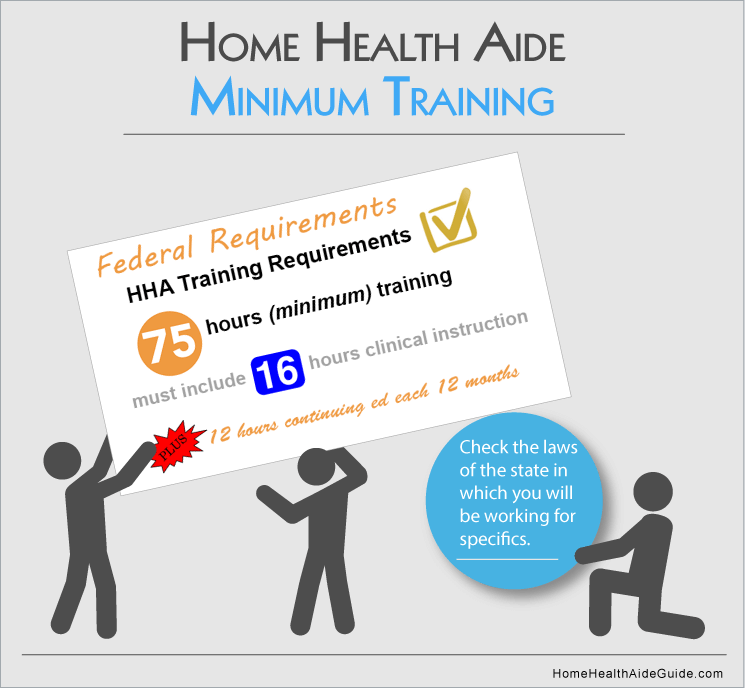
So, you wanna be an HHA? Awesome. First things first, you gotta meet some basic requirements. Most states will want you to be at least 18 years old. Sounds obvious, right? But you’d be surprised. You’ll also need a high school diploma or GED. If you don’t have one, some programs might offer alternatives, but it’s usually a standard prerequisite.
Background Checks: No Getting Around This
This is a biggie. Because you’ll be working closely with vulnerable individuals, a clean criminal record is non-negotiable. Expect a thorough background check, including fingerprinting. Any serious offenses, especially those involving children or the elderly, will likely disqualify you. It’s all about patient safety, after all.
Health Screenings: Are You Fit for the Job?
You also need to be in decent physical shape. Home health care can be demanding. You might need to lift and transfer patients, stand for long periods, and generally have the stamina for physical tasks. A health screening, including TB testing and proof of immunizations, is usually part of the deal. They want to Make sure you’re healthy enough to do the job and won’t pose a risk to clients.
The Core Competency Test
Beyond the paperwork and screenings, you’ve got to prove you know your stuff. This typically involves passing a competency exam. This isn’t some pop quiz; it covers Needed skills like taking Key signs, assisting with personal hygiene, basic first aid, and understanding infection control. You’ll need to demonstrate both knowledge and practical ability.
How Long Does Hha Certification Training Take Near Me
![Become a HHA in 4 weeks! [FREE guide to download]](https://homehealthaideguide.com/wp-content/uploads/how-long-to-be-hha-4-weeks.png)
Source : homehealthaideguide.com
The Time Commitment: It Varies!
Look, there’s no single answer here because it depends on a bunch of factors. You’ve got your state regulations, the specific training program’s structure, and whether you’re doing it full-time or part-time. It’s not like getting a driver’s license that’s standardized everywhere.
Typical Program Durations
Generally, expect the training itself to range anywhere from one to six weeks. Some accelerated programs might cram it into a shorter period, while others might spread it out. You’re looking at around 40-75 hours of classroom instruction and supervised practical training. This covers the Needed skills and knowledge you’ll need.
Factors Influencing Speed
Schedule. Are you able to dedicate yourself to this full-time, day in and day out? Or are you juggling it with other jobs or family responsibilities? Part-time training will obviously take longer. Also, some programs incorporate on-the-job training or clinical hours, which can extend the overall timeframe until you’re fully certified and ready to go.
Finding “Near Me” Options
When you search for “HHA certification training near me,” you’ll find community colleges, vocational schools, and sometimes even hospital systems offering courses. The scheduling and duration will vary significantly between these institutions. It’s worth calling a few places to get a feel for their class schedules and completion times. Don’t be afraid to ask directly: “How long until I’m certified?
How Much Does It Cost To Become Hha Certified

Source : research.com
The Price Tag: A Wide Spectrum
Okay, let’s talk money. The cost to get your HHA certification can swing pretty wildly. We’re talking anywhere from a few hundred bucks to over a thousand dollars. It really boils down to where you get your training and what’s included in the package.
Breakdown of Potential Expenses
You’ve got tuition for the course itself, which is usually the biggest chunk. Then, there are fees for things like background checks, drug screenings, textbooks, uniforms, and the certification exam. Some programs might bundle these, while others nickel-and-dime you for every little thing. It’s Key to get a full cost breakdown before you sign up.
Comparing Training Costs
Here’s a little something to chew on. Community colleges and vocational schools often offer more affordable options compared to private training centers. However, private centers might have more flexible scheduling. You’ve also got those free online HHA programs we touched on earlier, but remember those potential hidden costs we discussed.
| Training Provider Type | Typical Cost Range (USD) | Included Services | Pros | Cons |
|---|---|---|---|---|
| Community Colleges/Vocational Schools | $200 – $800 | Tuition, basic materials | Affordable, accredited | Less flexible scheduling |
| Private Training Centers | $500 – $1500+ | Varies widely, often extra fees | Flexible schedules, potentially faster | Can be more expensive, research accreditation |
| Free/Sponsored Programs | $0 – $200 (for fees) | Tuition usually covered | No tuition cost | Limited availability, potential hidden costs, commitment required |
Investigating Employer Sponsorship
Don’t forget to check if any local healthcare agencies or home care companies offer to pay for your training. Many do! They need qualified HHAs, so they’re willing to invest in people. It’s a fantastic way to reduce the cost, though it usually comes with a work commitment. You can learn more about the career path on sites like Visiting Angels.
Hha Vs Cna Certification What Is The Difference
Source : hhstaff.com
The Core Roles: Similar but Distinct
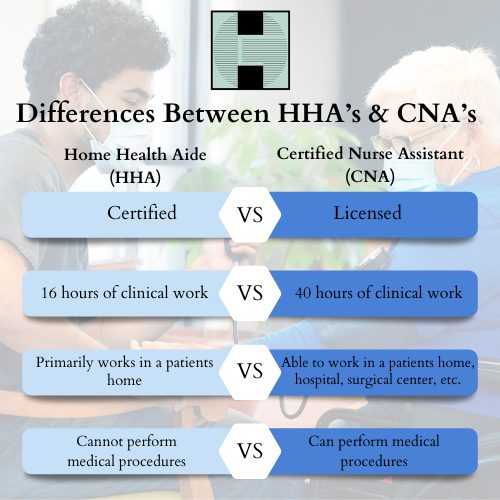
People get confused, and that’s okay. Both HHAs (Home Health Aides) and CNAs (Certified Nursing Assistants) work in healthcare, providing direct patient care. But their scope of practice and typical work environments are where they really diverge. Think of it like this: CNAs are often the frontline staff in more clinical settings, while HHAs focus on care within a patient’s home.
Work Settings and Patient Interaction
A CNA most commonly works in hospitals, nursing homes, or assisted living facilities. They’re usually part of a larger medical team, reporting to nurses. An HHA, on the other hand, primarily works in a patient’s private residence. This means the care is more personalized, and the HHA often has more autonomy in managing the daily schedule and addressing the patient’s needs in their own environment.
Training and Certification Differences
The training requirements also differ. CNA programs are generally longer and more intensive than HHA programs. CNAs typically undergo around 100-150 hours of training, including extensive clinical practice. HHA training hours can vary but are often shorter, focusing on skills specific to home-based care. Both require passing a state-recognized exam to earn certification, but the content and emphasis will be different. You can find more details on these career paths at places like Visiting Angels.
Scope of Practice: What Can They Do?
While both assist with daily living activities (bathing, dressing, eating), CNAs might have a broader scope in clinical settings, sometimes assisting with more complex medical tasks under direct supervision, like certain wound care or catheter care. HHAs focus on making the home safe and accessible, providing companionship, light housekeeping, meal preparation, and Needed personal care. They are Key for enabling individuals to remain independent at home.
Frequently Asked Questions
Can I get my HHA certificate online?
Sort of, but not entirely. You’ll definitely have to do hands-on training, which means showing up in person. Some of the classroom stuff, like anatomy or patient rights, might be doable online. But that practical, real-world experience? Gotta be there for that.
Who gets paid more, HHA or CNA?
Generally, a CNA certificate usually means a bit more pay than an HHA. CNAs often have more training hours under their belt and can do a wider range of tasks, especially medical ones. Think of it like this: HHA is great for personal care, but CNA often opens doors to more clinical settings and higher wages.
How long does it take to get a HHA certificate in NY?
In New York, most HHA training programs are pretty quick, usually around 75 hours. You could potentially knock it out in a few weeks if you go full-time. But remember, that’s just the training part. Passing the exam and getting officially certified might add a little extra time.
What are the basic requirements to start HHA training?
It’s not rocket science. Usually, you just need a high school diploma or GED, a clean background check (they really don’t want criminals caring for people), and to be at least 18. Some places might have a basic health screening too, just to make sure you’re up for the physical demands.
Is HHA certification valid nationwide?
Not always. While the core skills are similar, each state has its own rules and requirements for HHA certification. So, if you get certified in one state, you might need to do some extra paperwork or even a bit more training to be recognized in another. It’s always best to check the specific state’s regulations.
