How Long Does EMT Certification Training Actually Take? Let’s Get Real.
So, you’re thinking about becoming an EMT, huh? Awesome. It’s a noble path, no doubt. But before you dive headfirst into scrubs and sirens, there’s a big question looming: just how long is this whole certification training thing going to take? Forget the fuzzy timelines you’ve probably stumbled across online. We’re cutting through the noise here, getting down to brass tacks, and giving you the unvarnished truth about the time commitment for EMT. It’s not a simple flick of a switch, that’s for sure. It demands dedication, a solid chunk of your time, and a willingness to learn – fast.
This isn’t just about ticking boxes on a checklist. It’s about preparing yourself for high-stakes situations where lives literally hang in the balance. Getting your EMT certification is a serious undertaking. It involves rigorous coursework, hands-on training, and critical exams. Let’s break down precisely what you’re signing up for, section by section, so you can make an informed decision and plan your life accordingly. No sugar-coating here, just the facts you need to know to navigate this Key first step in your emergency medical career.
The Real Clock: Breaking Down EMT Training Duration
Source : hci.edu
Understanding the Core Coursework Length
The heart of your EMT journey is the actual training program. This isn’t some weekend workshop. We’re talking about a Large block of time dedicated to learning the fundamentals of emergency medicine. Most foundational EMT courses, often called EMT-Basic or EMT-B, typically run anywhere from 120 to 180 hours. That might sound manageable on paper, but it’s packed. It’s a concentrated dose of medical knowledge, from anatomy and physiology to patient assessment and basic life support procedures. You’ll be hitting the books hard and absorbing a ton of information.
Think of it like cramming for the most important exam of your life, but over several weeks or months. The pace is often relentless. You’ll be covering everything from how to treat a broken bone to administering CPR and managing a choking victim. This core curriculum is the bedrock upon which all your future medical skills will be built. Get this right, and you’re setting yourself up for success. Rush it, and you risk missing Key details that could matter when seconds count.
Program Formats: Full-Time vs. Part-Time & Their Impact
Now, how that 120-180 hours shakes out depends heavily on the program format you choose. The full-time, intensive programs are the speed demons. These can often be completed in as little as 4 to 8 weeks. Imagine going to class basically every day, Monday through Friday, for several hours. It’s a full-time job, essentially, but with way more life-or-death implications. This is perfect if you can dedicate yourself entirely, perhaps taking a break from work or using a fast-track approach.

Source : respondright.com
On the flip side, the part-time options are the marathon runners. These programs spread the same coursework out over a longer period, often 3 to 6 months, sometimes even up to a year. They usually meet a few evenings a week and on weekends. This is ideal for those juggling other commitments – a job, family, or other studies. The trade-off? It takes longer to get certified. But hey, no one’s judging the path, just the destination. It’s all about finding what fits your life best.
Weekend and Evening Classes: The Extended Timeline Reality
Let’s get specific. If you’re eyeing those weekend-only EMT courses, you’re definitely signing up for the longer haul. These programs are designed for maximum flexibility, but they stretch the training duration considerably. You might be looking at six months to over a year to complete the required hours. It requires sustained commitment, showing up consistently week after week. It’s easy to lose momentum over such an extended period. You need serious discipline to keep pushing forward.
Similarly, evening classes, while accommodating a typical workday, also extend the timeline. You’re still covering the same critical material, but in smaller chunks spread across more weeks. Think about it: instead of a few hours every day, you might have a few hours twice a week. This means the total calendar time balloons. It’s a trade-off between immediate immersion and fitting training around your existing life. Both are valid, but the time to complete EMT training will be significantly different.
Beyond the Classroom: Needed Steps Adding to the Clock
Clinical Rotations and Field Internships: The Practical Hours
Alright, so you’ve aced the lectures and aced the practical skills drills. Great. But the training clock doesn’t stop there. A Key component of EMT certification involves hands-on clinical experience. This means spending time in actual emergency settings. You’ll be riding along with experienced EMTs and paramedics, observing and participating in real calls. These EMT clinical hours are non-negotiable and add significant time to your training.
Typically, you’ll need to complete a set number of hours, often around 10-20 shifts, depending on the program and state requirements. This isn’t just passive observation, either. You’ll be actively involved in patient care under supervision. These rotations can take weeks to schedule and complete, especially if you’re trying to fit them around a job. It’s where theory truly meets reality, and it’s Key for developing your competence and confidence. Don’t underestimate the time this adds.
Background Checks and Paperwork: The Administrative Lag
Let’s not forget the often-tedious, yet utterly Needed, administrative side of things. Getting certified isn’t just about passing tests; it involves a whole lot of background checks, fingerprinting, and paperwork. Each state has its own specific requirements, and these processes can sometimes involve waiting periods. You might need a criminal background check, drug screening, and physical examinations. These aren’t instant. They require coordination and can take anywhere from a few weeks to a couple of months to process.
Think of it like getting a security clearance – it’s thorough, and it takes time for all the checks to come back clean. This administrative phase is a necessary hurdle. It ensures that only qualified and trustworthy individuals enter the field. While it doesn’t involve direct medical training, it absolutely contributes to the overall timeline from deciding to become an EMT to actually holding that certification in your hand. It’s a bottleneck you have to plan for.
State-Specific Licensing and Registration: The Final Hurdle
Once you’ve successfully completed your training program and passed the national certifying exam (more on that later), you’re not quite done yet. You still need to obtain your actual state EMS license or certification. Each state operates its own EMS agency, and they all have their own application processes, fees, and processing times. This final step can add another layer of waiting. Some states are quicker than others, but you could be looking at an additional 2-6 weeks, or even longer in some cases, for your official state credentials to be issued.

Source : compumed.edu
This is the bureaucracy kicking in. You’ve done the hard work; now you just have to wait for the official stamp of approval. It’s Key to start this application process as soon as you’re eligible. Don’t let it linger. Delaying this final step means delaying your ability to actually work as an EMT. It’s the last hurdle, and it’s one that requires patience and attention to detail. Getting your state EMT license is the final gate.
The Big Exam: NREMT and Its Role
Understanding the National Registry of Emergency Medical Technicians (NREMT)
Okay, let’s talk about the big one: the NREMT exam. This is the standardized test that most states use to assess a candidate’s competency. Passing the NREMT is often a prerequisite for state licensure. It’s a computer-adaptive test, meaning the difficulty adjusts based on your answers. Get a question right, and the next one gets harder. Get it wrong, and it gets easier. It’s designed to accurately pinpoint your knowledge level.
This exam covers a vast range of material from your training. It tests your critical thinking skills and your ability to apply medical knowledge under pressure. It’s not a simple multiple-choice quiz. The questions are scenario-based, forcing you to think like a real EMT. Preparing for and passing this exam is a significant milestone. You don’t just wing it; dedicated study is a must. The actual NREMT exam process itself includes applying, scheduling, and waiting for results.
Scheduling and Taking the NREMT Exam
So, how long does the exam process take? After completing your approved EMT course, your program will typically help you register with the NREMT. Once approved, you’ll receive an Authorization to Test (ATT). This ATT usually has an expiration date, so you can’t wait too long. You then schedule your exam appointment at a testing center. Depending on the testing center’s availability in your area, you might be able to get an appointment within a week or two of receiving your ATT.
The exam itself usually takes about 2 to 2.5 hours to complete. After you finish, you typically get your pass/fail results immediately at the testing center. However, the official confirmation and score report can take a few days to a week to be processed and officially recorded by the NREMT. So, while the test is relatively short, the lead-up and official processing add to the overall timeline. It’s another piece of the puzzle that adds weeks to your journey.
Retakes and the Extended Timeline
What happens if you don’t pass the NREMT on your first try? It happens. Many candidates need to retake the exam. The NREMT allows you to retake the test, but there are specific waiting periods involved. You generally have to wait 15 days before you can reschedule and take the exam again. If you fail it a second time, there might be further waiting periods or additional requirements.
A failed attempt can easily add at least another month to your certification timeline, factoring in the wait, rescheduling, and study time for a retake. This is why thorough preparation is absolutely critical. You don’t want to be in a position where you have to go through this process multiple times. Every retake delays your ability to start working and earning as a certified EMT. Aim to pass it the first time around!
Factors Influencing the Total Time: It’s Not One-Size-Fits-All
Geographic Location and State Regulations
Here’s a big one: where you live matters. EMT certification requirements and timelines can vary significantly from state to state. Some states have more stringent training hour requirements or additional mandatory modules beyond the basic NREMT standard. For instance, a state might require specific training in areas like hazardous materials response or pediatric emergencies that adds to the total coursework hours. The state’s specific requirements are a major factor.
.png)
Source : go.bestpracticemedicine.com
The efficiency of the state EMS agency handling your final licensure can influence the timeline. Some states have streamlined online application systems, while others require extensive paper submissions and manual processing. Researching your specific state’s EMS agency website early on is a smart move. Understanding their unique regulations and typical processing times can help you set realistic expectations for your overall journey. It’s not a national average; it’s a state-by-state game.
Choosing Your Training Provider: School vs. EMS Agency
The type of institution where you complete your training can also play a role. Community colleges and private EMT schools often offer structured, semester-based programs that might follow a traditional academic calendar. These can be predictable but might take longer if they Match with longer academic terms. On the other hand, some EMS agencies offer their own in-house training programs, which are often more intensive and faster-paced, aiming to quickly get new recruits into the field.
These agency-sponsored programs can sometimes be quicker, but they might also come with a service commitment – you agree to work for them for a certain period after certification. Private schools can vary wildly in pace and cost. It’s Needed to investigate the specific curriculum, schedule, and duration of any program you’re considering. Don’t just look at the price tag; look at the clock. A shorter program might save you time but could be more expensive upfront.
Personal Learning Pace and Study Habits
Let’s be honest, we all learn differently. Some people absorb information like a sponge, while others need more time and repetition. Your personal learning pace and how effectively you study will inevitably influence how quickly you master the material and how well you perform on exams. If you find certain medical concepts challenging, you might need to dedicate extra hours outside of class to review and practice. This personal investment of time is Key for success.
Your study habits are critical. Are you someone who can power through dense textbooks, or do you need to visualize concepts with diagrams and practice scenarios? Tailoring your study approach to your strengths can make a huge difference. Likewise, your ability to retain information for the NREMT exam is Top. Effective studying isn’t just about logging hours; it’s about productive learning. Don’t be afraid to seek extra help from instructors or study groups if you need it. This self-awareness can shave off time or, conversely, add it if neglected.
The Full Timeline: Putting It All Together
Scenario 1: The Fast-Track Intensive Program
Let’s paint a picture. You find an intensive, full-time EMT course offered by a local training center or EMS agency. These programs are designed to move quickly. You complete the 120-180 hours of coursework in about 6-8 weeks of full-time study. Immediately after finishing, you apply for and take your NREMT exam, passing it on the first try (let’s be optimistic here!). You submit your state licensure application right away. Assuming smooth processing, you could potentially be fully certified and ready to work in as little as 3 to 4 months from your very first day of class. This is the express lane, requiring total dedication.
Scenario 2: The Standard Part-Time Approach
Now, consider the more common scenario. You enroll in a part-time EMT program, perhaps attending classes a couple of nights a week and some Saturdays. This stretches the coursework over, say, 4-6 months. After completion, you dedicate a couple of weeks to focused NREMT exam preparation and take the test, passing it. Then, you submit your state application, which takes another month to process. In this more typical scenario, the total time from starting your EMT training to being licensed might hover around 6 to 9 months. This is a realistic timeframe for many working adults.
Scenario 3: The Extended or Delayed Path
Finally, let’s look at the extended timeline. Maybe you chose a weekend-only program that lasts close to a year. Or perhaps you had to delay your NREMT exam due to scheduling conflicts, or unfortunately, you needed to retake it. Add to that potential delays in background checks or state paperwork. In situations like these, it’s not uncommon for the entire process, from the initial enrollment in an EMT course to holding your active certification, to take 9 months to over a year. This isn’t necessarily a bad thing; it just reflects a different pace and set of circumstances. The key is knowing what path you’re on.
Source : unitekemt.com
Making the Most of Your EMT Training Time
Prioritizing Your Education: It’s More Than Just a Course
Look, becoming an EMT isn’t like picking up a hobby. This is a profession where your actions have direct consequences on people’s health and lives. Therefore, approaching your EMT training with the seriousness it deserves is Top. Don’t just think of it as a hoop to jump through. Understand that every lecture, every practical skill session, and every clinical hour is designed to equip you with the knowledge and abilities necessary to function effectively and safely in a high-stress environment. Treat your EMT education as the critical foundation it is.
Dedicating sufficient time to studying, actively participating in class, asking questions, and seeking clarification whenever needed. If a concept isn’t clicking, don’t just let it slide. Dive deeper. Use all the resources available to you – your instructors, textbooks, online materials, and fellow students. The more effort you put in now, the better prepared you’ll be, and the smoother your certification journey will likely be. Your commitment directly impacts the quality of your training.
Leveraging Resources for Faster Progress
Time is money, and in this case, it’s also about getting into a rewarding career faster. To Improve your timeline, make sure you’re leveraging all available resources effectively. Many training programs offer supplementary materials, practice exams, or online study modules. Take advantage of these! They are specifically designed to reinforce the material and prepare you for the NREMT exam. Websites like Indeed offer career advice that can often touch on the steps involved in getting certified, providing valuable insights. You can find articles detailing the path to becoming an EMT, which can help clarify the process and potential timelines for anyone pursuing this career.
Additionally, form study groups with your classmates. Teaching concepts to others is a fantastic way to solidify your own understanding. Don’t hesitate to reach out to instructors during their office hours with specific questions. The faster you grasp the material, the less likely you are to fall behind or need remedial study. Efficient learning speeds up the entire process. Think of it as smart studying, not just hard studying. This strategic approach can significantly shorten the time it takes to complete EMT training.
Networking Early: Building Connections for the Future
While you’re in the thick of your EMT training, don’t forget about the people around you. Your instructors are often experienced professionals with extensive networks. Your classmates are your future colleagues. Start building relationships from day one. Attend any program-specific events or career fairs if they are offered. Sometimes, your training program might even have partnerships with local EMS agencies, offering a more direct route to employment. These connections can be Crucial.
Sometimes, the best job opportunities aren’t advertised widely. They come through word-of-mouth. Having a strong network means you’ll be among the first to know when positions open up. Furthermore, experienced EMTs and paramedics you meet during your clinical rotations can offer practical advice, mentorship, and even job leads. Don’t underestimate the power of professional relationships. Building these connections early can not only make your training experience more enriching but can also significantly speed up your transition into a career as an EMT once you’re certified.
Preparing for the Next Steps: What Comes After Certification?
The Job Search and Application Process
So, you’ve got that shiny new EMT certification in hand. Congratulations! But the journey doesn’t end there. Now comes the job hunt. The application process for EMS positions can vary. Some agencies have very detailed online applications, requiring you to upload certifications, references, and detailed work history. Others might have a more straightforward process, perhaps starting with an initial screening or a quick phone interview. Expect to submit resumes and cover letters.
Source : lifelineamb.org
The time it takes to land a job can depend on the demand for EMTs in your area and the specific hiring cycles of different agencies. It might take a few weeks of active searching and interviewing. Some smaller private services or volunteer departments might have quicker hiring processes than larger municipal fire departments. Be prepared for interviews that may include scenario-based questions to assess your decision-making skills under pressure. Landing that first EMT job is the next big step.
Continuing Education and Advanced Certifications
Your EMT certification isn’t a “set it and forget it” kind of deal. To maintain your license, you’ll need to complete continuing education (CE) hours regularly, typically every two years. These CE courses keep your skills sharp and update you on the latest medical protocols and advancements. The time and cost associated with these requirements are ongoing but necessary.
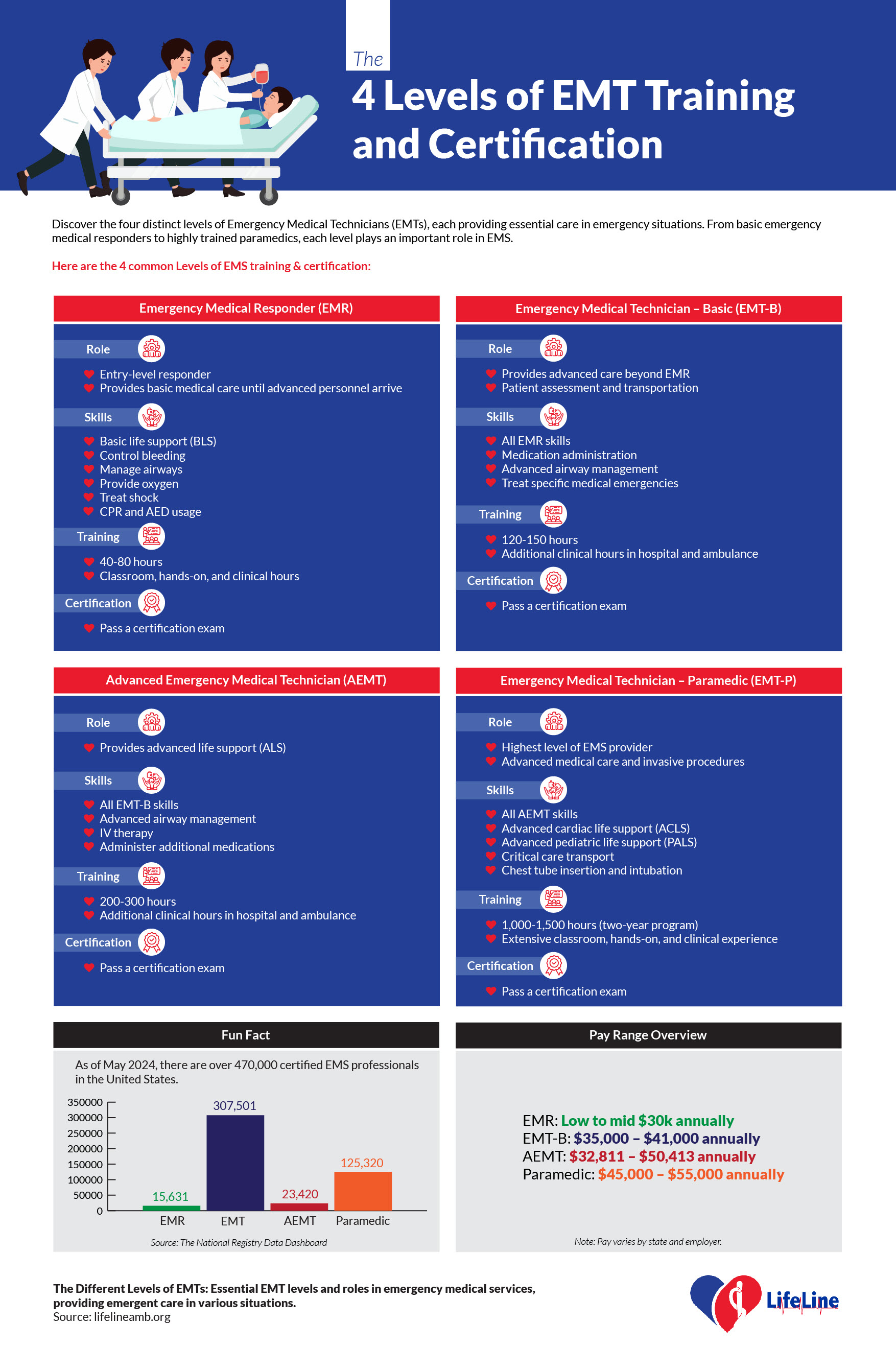
Beyond that, many EMTs use their certification as a stepping stone to further education and advanced roles. You might consider pursuing your Advanced EMT (AEMT) or Paramedic certification. These higher levels require significantly more training – often another year or two of intensive study and clinicals. For example, becoming a paramedic could involve completing an accredited paramedic program, which can take anywhere from 12 to 24 months, often including an Associate’s degree. The path from EMT to paramedic is a common and rewarding one, but it represents a Large additional time investment in education.
Career Advancement Opportunities
The EMT role is often just the beginning of a long and varied career in healthcare. From your initial certification, you can move into numerous specialized roles or related fields. You could become a firemedic, work in hospital emergency departments, or even pursue careers in public health, medical dispatch, or healthcare administration. Some EMTs transition into nursing, physician assistant programs, or other advanced medical professions, using their foundational EMS experience as a strong launching point. The skills and experience gained as an EMT are highly transferable across the healthcare sector.
Consider the vast array of possibilities. You might find yourself working in critical care transport, flight nursing, or even pursuing management roles within an EMS agency. The initial time spent obtaining your EMT certification opens doors to a multitude of career paths, many of which offer significant growth potential and the chance to make an even greater impact. Your EMT training is the key that unlocks these future opportunities.
| Stage of Certification | Typical Time Range (Weeks) | Notes |
|---|---|---|
| EMT Basic Coursework (120-180 hrs) | 4 – 26 | Depends heavily on full-time vs. part-time/weekend format. |
| Clinical Rotations/Internship | 2 – 8 | Can overlap with coursework in some programs; scheduling dependent. |
| NREMT Exam Application & Scheduling | 1 – 4 | Includes waiting for ATT and securing a test date. |
| NREMT Exam & Official Results | 1 – 2 | Exam is short; processing adds time. |
| State Licensure Application & Processing | 2 – 8 | Includes background checks; highly variable by state. |
| Buffer/Retake Time (if needed) | 4+ | Highly variable, adds significant time if exams are failed. |
| Total Estimated Time (Fast Track) | 13 – 22 | Achievable with intensive commitment and first-time passes. |
| Total Estimated Time (Standard Pace) | 20 – 40+ | More common for part-time students or those with minor delays. |
So, there you have it. The timeline for EMT certification isn’t a single, fixed number. It’s a range, heavily influenced by your choices and circumstances. Whether you opt for a breakneck intensive course or a more leisurely part-time schedule, remember that the goal is Full preparation. The time you invest now is a direct investment in your ability to provide critical care when it matters most. Planning realistically based on these factors is key to a successful journey into the rewarding world of emergency medical services. Don’t just aim to finish; aim to be excellent. You can learn more about the general career path and timeframes involved by checking out resources like Indeed’s career advice.
Frequently Asked Questions
How fast can you get an EMT certification?
Because it varies, but honestly, some accelerated EMT programs can get you certified in as little as 4 to 6 weeks. Others are more spread out and might take a few months. Depends on the course format and your dedication, you know?
Who gets paid more, EMT or EMS?
It’s a bit of a trick question ’cause EMT is a type of EMS, but generally, if you’re talking about higher levels within Emergency Medical Services, like paramedics, they usually earn more than basic EMT providers. More training, more pay, typically.
What disqualifies you as an EMT?
A lot of things could disqualify you, man. Things like serious felonies, especially those involving violence or drugs. Also, a history of substance abuse, certain medical conditions that might impair your ability to do the job, and sometimes even a poor driving record can be a disqualifier for EMT.
How long does EMT training typically take?
For a standard EMT certification course, you’re generally looking at somewhere between 110 to 160 hours of instruction. This usually breaks down to about 4 to 8 weeks if you’re doing it full-time, or longer if it’s part-time.
Can I become an EMT online?
You can do a lot of the coursework online, for sure, but you can’t complete the entire EMT certification that way. The hands-on skills, clinical rotations, and final exams? Gotta be in person. So, blended learning is the way most online options work.
