The Nitty-Gritty: What Education Do You REALLY Need for QMHP Certification?
So, you’re looking to get certified as a QMHP, huh? Good for you! It’s a noble path, helping folks navigate some tough mental health waters. But let’s cut the fluff. Forget those vague descriptions that leave you scratching your head. We’re diving deep into the actual educational requirements you’ll need to jump through. This isn’t some academic exercise; it’s about getting you qualified to make a real difference.
Think of it like this: you wouldn’t trust a chef who’s only read about cooking, right? Same applies here. The board wants to see that you’ve got the chops, the academic grounding, to handle the sensitive work involved. It’s about more than just wanting to help; it’s about being equipped. Let’s break down exactly what that looks like.
Master’s Degrees: The Golden Ticket?

Source : coursehero.com
QMHP certification, a Master’s degree often pops up. And not just any Master’s, mind you. There are specific fields they look for. It’s the bedrock for many pathways to certification.
Counseling & Psychology Programs
Most commonly, degrees in Counseling, Psychology, or Social Work are the standard bearers. These programs are designed to equip you with the theoretical knowledge and practical skills needed. You’re talking coursework in psychopathology, human development, ethics, and therapeutic techniques. It’s a solid foundation.
Marriage and Family Therapy (MFT)
Don’t overlook MFT programs! If your goal is to work with families and couples, an MFT Master’s is often a direct route. These degrees hone in on systemic approaches, understanding family dynamics, and facilitating relational healing. It’s a specialized but highly relevant path.
Other Related Master’s Fields
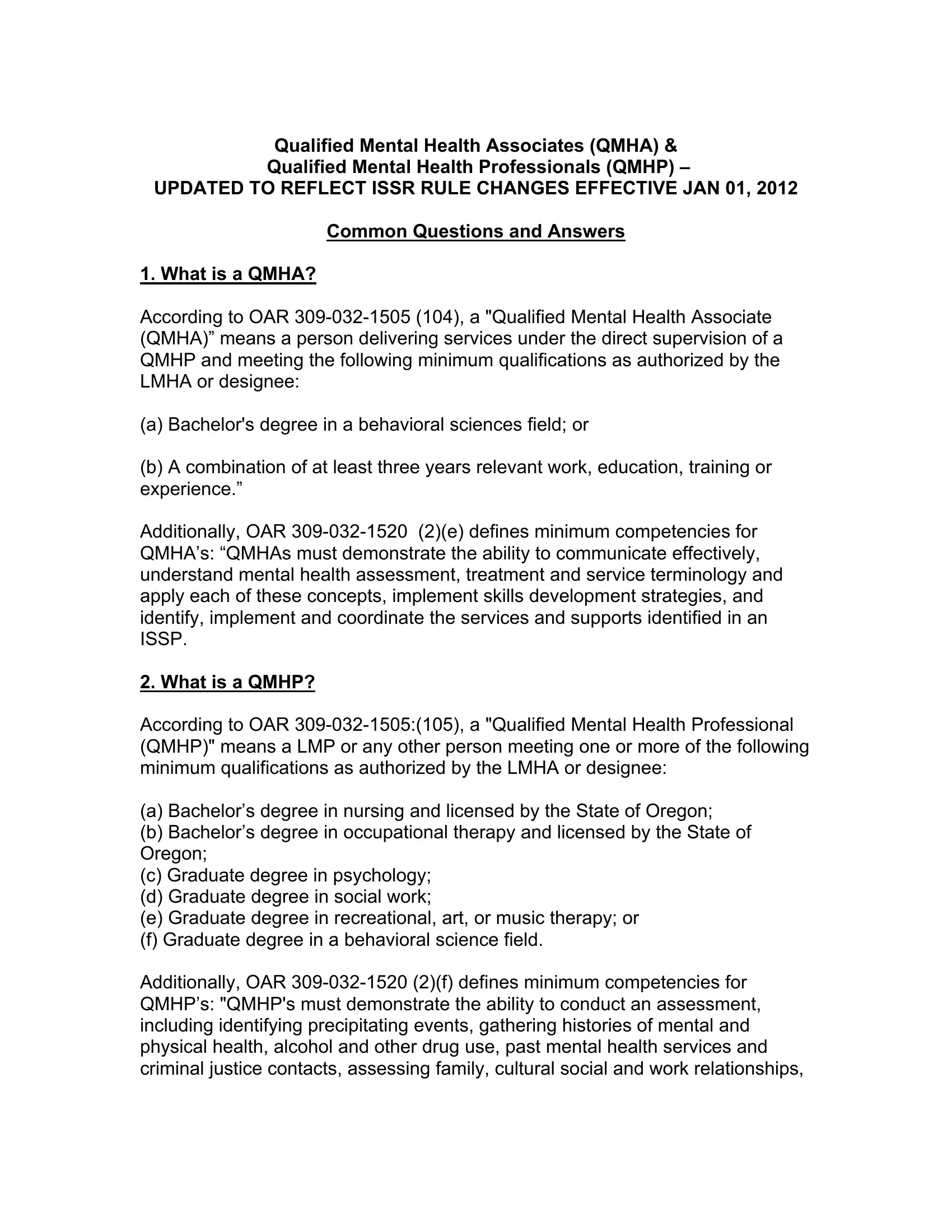
What if your Master’s isn’t directly in counseling? It’s not always a dead end. Degrees in areas like psychiatric nursing, education with a focus on counseling, or even some specialized areas of sociology might count. It really depends on the specific state and the coursework contained within. Always check the board’s guidelines for these scenarios. They’ll want to see specific clinical coursework.
Source : formspal.com
The Bachelor’s Degree Route: Is It Possible?
Can you get QMHP certified with just a Bachelor’s? Sometimes. It’s a bit more nuanced and often depends heavily on the state and the specific type of QMHP you’re aiming for. Don’t assume it’s impossible, but be prepared for extra hoops.
Specific Bachelor’s Degrees
Generally, if a Bachelor’s is accepted, it will be in fields like Psychology, Social Work, Sociology, or Human Services. These provide a foundational understanding of human behavior and societal structures. But that’s just the start. You’ll likely need more.
The Experience Factor
A Bachelor’s degree alone rarely cuts it. Expect to need significant, supervised clinical experience post-graduation. We’re talking years of working directly with clients under the guidance of licensed professionals. This is where you build the practical skills the degree only hints at. Think of the guy running a small accounting firm; he needed years of hands-on experience on top of his degree.
Additional Certifications or Coursework
In many cases, a Bachelor’s plus experience will require you to complete specific additional coursework or obtain other certifications. This could be a certificate program in a relevant field or a specific set of training hours designed to bridge the gap between your degree and the QMHP standards. It’s about demonstrating competency beyond the basic degree.
Core Coursework Requirements: What You MUST Study
Regardless of whether you have a Bachelor’s or a Master’s, the content of your education matters. They aren’t just looking at the degree title; they’re scrutinizing the curriculum. What did you actually learn?
Clinical Skills and Theories
You absolutely need coursework that covers clinical skills and theories. This includes areas like assessment, diagnosis (DSM knowledge is key!), treatment planning, and various therapeutic modalities (e.g., CBT, DBT, psychodynamic therapy). Without this, you’re missing the core knowledge base.
Human Growth and Development
Understanding the human lifecycle is non-negotiable. Courses covering child development, adolescent psychology, adult development, and gerontology are Key. You need to know how people change and grow (or struggle to) across their lifespan. It informs everything you do.
Ethics and Professional Conduct
This is huge. You’ll need dedicated coursework in professional ethics. This covers confidentiality, boundaries, dual relationships, informed consent, and understanding the legal and ethical responsibilities of working in mental health. Messing this up can have serious consequences.
Cultural Competency and Diversity
The world is diverse, and mental healthcare must reflect that. Expect required courses that focus on cultural competency, understanding different cultural backgrounds, biases, and how these impact mental health and treatment. Being sensitive and effective across diverse populations is a must.
Supervised Experience: The Real-World Proof
Education is one thing, but proving you can apply it is another. Supervised experience is where theory meets practice. It’s often a make-or-break requirement for certification.
Source : intercoast.edu
What Constitutes “Supervised” Experience?
This isn’t just working at a community center. It means working under the direct supervision of a licensed mental health professional (like an LPC, LCSW, LMFT, or psychologist). You’ll be logging client hours, discussing cases, and receiving feedback regularly. It’s a structured learning environment.
Hours and Duration Requirements
The number of hours required varies significantly by state and by the type of QMHP credential you’re seeking. Some might require 2,000 hours, others 4,000 or more. There are usually specific weekly hour requirements for supervision as well. Check the specific regulations for your area. The QMHP Instructions PDF offers detailed guidance on this for South Dakota, for instance.
Documentation is Key
You can’t just claim you did the work. You’ll need Careful documentation. This includes logs of client contact hours, supervisor notes, and verification forms signed by your supervisor. Start keeping records from day one; you don’t want to be scrambling later.
State-Specific Variations: Don’t Assume Uniformity
Here’s the kicker: QMHP certification isn’t a one-size-fits-all deal. Requirements can differ wildly from one state to another. What flies in California might not cut it in Ohio.
Understanding Your State Board
Your first move should always be to identify the specific board or agency that governs QMHP certification in your state. This is your ultimate source of truth. They will have official documentation outlining all the educational and experiential requirements. For example, the MHACBO site provides information relevant to QMHP-R registration in Oregon.
Master’s vs. Bachelor’s Nuances
Some states might heavily favor Master’s degrees, making a Bachelor’s route extremely difficult, if not impossible. Others might have specific programs or roles where a Bachelor’s with Large experience is perfectly acceptable. You have to do your homework for your specific location.
Approved Programs and Degrees
States often have a list of “approved” programs or degrees that meet their criteria. If your degree isn’t on the list, you might need to prove that your coursework is equivalent through a transcript review. It’s a bureaucratic hurdle, but a necessary one.
The Examination Component: Testing Your Knowledge
Beyond education and experience, many QMHP certifications require you to pass a standardized exam. This is your final academic hurdle.
National vs. State Exams
Depending on the state and the specific credential, you might take a national exam (like the NCE for counselors) or a state-specific exam. These exams test your knowledge of clinical practice, ethics, and relevant laws.
Preparation is Key
Don’t just wing it. Treat the exam prep seriously. Use study guides, practice tests, and consider exam review courses. You’ve put in the work to get your education; give the exam the respect it deserves.
Source : ehscareers.com
Putting It All Together: A Sample Scenario
Let’s paint a picture. Sarah wants to be a QMHP. She earned a Master’s in Clinical Social Work from an accredited university. Her program included extensive coursework in diagnosis, ethics, human development, and group therapy. After graduation, she completed 3,000 hours of supervised clinical work at a community mental health center, with weekly individual supervision sessions. She passed the state’s licensing exam. Sarah meets the educational and experiential requirements in her state.
Now consider Mark. He has a Bachelor’s in Psychology and worked for five years as a mental health technician. While valuable, this experience might not meet the “supervised clinical experience” criteria in many states. He likely needs to return for a Master’s degree or find a very specific QMHP role that accepts his background with additional training. It’s a tough distinction, but a critical one.
Data Table: QMHP Educational Pathways at a Glance
| Degree Level | Typical Majors/Fields | Key Considerations | Likelihood of Meeting Requirements |
|---|---|---|---|
| Master’s Degree | Counseling, Social Work, Psychology, MFT, Psychiatric Nursing | Accredited program, core clinical coursework (diagnosis, ethics, etc.), supervised experience Key. | High – Often the standard route. |
| Bachelor’s Degree | Psychology, Social Work, Sociology, Human Services | Significant supervised clinical experience mandatory, often requires additional certifications or coursework, state-dependent. | Moderate to Low – Highly dependent on state and specific role. |
| Certificate Programs | Various (often post-bachelor’s or post-master’s) | Usually supplements a degree, focuses on specific skills or populations, not typically a standalone qualification for QMHP. | Low – Generally not sufficient on its own. |
This table just gives you a rough idea. Don’t take it as gospel truth for every single state. Always, always verify with your specific state’s governing body. They are the ultimate arbiters of who gets certified and who doesn’t.
Final Thoughts: It’s a Marathon, Not a Sprint
Getting QMHP certified is a significant undertaking. It requires dedicated education, rigorous practical experience, and often passing a challenging exam. The educational requirements are designed to Make sure you’re competent and ready to handle the demanding, yet incredibly rewarding, work of supporting individuals with mental health challenges. So, roll up your sleeves, do your research specific to your state, and get ready to put in the work. Your future clients are counting on it.
Frequently Asked Questions
What’s the minimum education needed for QMHP certification?
Because most states require abachelor’s degree in a related field, like social work, psychology, or counseling. Some might consider a master’s, but a bachelor’s is pretty standard to start.
Are there specific degrees that are better for QMHP certification?
But generally, degrees in human services, sociology, or even psychiatric nursing can work. The key is that the coursework covers relevant areas like human behavior, mental health, and counseling techniques.
Do I need any specific coursework or training?
Yeah, definitely. You’ll often need coursework in areas like abnormal psychology, human development, and ethics. Plus, some programs require practical experience or supervised internships.
What if my degree isn’t directly in a mental health field?
It depends on the state’s specific rules, but often you can still qualify if your degree has a significant number of credits in relevant subjects. You might need to take some additional courses to bridge the gap for your QMHP application.
How long does the educational process usually take?
Well, a bachelor’s degree is typically four years. Then, you might have specific certification programs or additional training on top of that. So, think at least four years, plus any extra steps for the actual certification process.
