Conquering the CMA (AAMA) Exam: Your Ultimate Timeline Guide
So, you’re gunning for that CMA (AAMA) credential, huh? Smart move. It’s not just a piece of paper; it’s your golden ticket into a profession that actually matters. But let’s be real, the path to passing the exam isn’t always a straight shot. It’s a journey, and knowing the map—or in this case, the timeline to pass the AAMA Certified Medical Assistant exam—is absolutely Key for success. Forget those generic guides that just skim the surface; we’re diving deep into what it really takes, step by step. This isn’t just about studying; it’s about strategic planning.
Think of it like training for a marathon. You wouldn’t just show up on race day, right? Nah. You need a training plan, consistent effort, and a clear understanding of your race day strategy. The CMA (AAMA) exam is no different. We’re talking about turning ambition into accreditation, and that requires a solid, actionable timeline. Ready to get your ducks in a row?
Laying the Groundwork: Pre-Application Essentials

Source : acmso.org
Before you even think about booking a test date, there’s some heavy lifting to do. This phase is all about ticking the non-negotiable boxes. Get this wrong, and the rest of your timeline goes up in smoke. It’s foundational stuff, plain and simple.
Understanding Eligibility Requirements
First things first: are you even eligible to sit for the exam? This isn’t a suggestion; it’s the absolute gatekeeper. The American Association of Medical Assistants (AAMA) has specific criteria. You can’t just decide one day you want to be a CMA. You need to meet their educational and professional standards. Checking the official AAMA certification page is your first, critical homework assignment.
This typically involves graduating from an accredited medical assistant program. We’re talking programs that meet specific educational standards set by accrediting bodies. Or, you might qualify through extensive on-the-job experience if you meet certain conditions. Don’t guess on this. Double-check the details to avoid wasting precious time.
Choosing Your Educational Path
For most folks, the journey to eligibility starts with formal education. This could be a certificate program, an associate’s degree, or even a bachelor’s degree with a focus on medical assisting. Each path has a different time commitment. A certificate program might take less than a year, while an associate’s degree usually clocks in around two years. This choice significantly impacts your overall timeline to pass the AAMA exam.
Consider your personal circumstances. Do you need to work full-time while studying? Are you able to commit to a full-time student schedule? Think about accredited institutions. Make sure any program you enter is recognized and will fulfill the AAMA’s strict requirements. A program that isn’t accredited? That’s a dead end for CMA certification.
Gathering Necessary Documentation
Once you’re in or have completed your program, you’ll need documentation. This means transcripts, proof of graduation, and potentially letters of recommendation or affidavits if you’re qualifying via experience. The AAMA needs proof that you’ve met their stringent educational prerequisites. This isn’t the time to be scrambling for papers.
Start gathering these documents early. Sometimes, getting official transcripts can take weeks. Build this buffer into your plan. Missing a single required document can delay your application and, consequently, your exam date. It’s the bureaucratic dance, and you need to lead.
The Application Process: Handling the Paperwork Maze
Alright, you’ve met the prerequisites. Now comes the part where you officially signal your intent to the AAMA. The application process itself takes time and attention to detail. Rushing this stage is a rookie mistake.
Source : mometrix.com
Submitting Your Application to the AAMA
This is where you formally apply to take the exam. You’ll need to fill out an application form, usually online, and submit all your supporting documentation. Make sure everything is accurate and complete. Any errors or omissions could lead to delays or even rejection of your application. Yes, it’s that serious.
Pay close attention to deadlines. The AAMA has specific application windows. Missing one means you might have to wait months to reapply. Factor in processing time; the AAMA doesn’t approve applications instantly. Give them a reasonable amount of time to review everything thoroughly. This stage alone can add weeks to your timeline.
Understanding Application Fees and Payment
There’s no getting around it: certification costs money. You’ll need to pay an application fee and an examination fee. These fees can change, so always check the latest figures on the AAMA website. Make sure you have the funds readily available when you submit your application. Unexpected costs can derail your carefully crafted schedule.
Know the payment methods accepted. Are you paying by credit card online? Do you need to mail a check? Make sure your payment is processed promptly. Delays in payment processing can stall your application further. It’s another small step that can have a big impact on your timeline to pass the CMA exam.
Waiting for Application Approval
After submission, you enter the waiting game. The AAMA reviews your application and documentation. This process can take several weeks. During this time, you can’t do much but wait. However, you can use this period productively. Start firming up your study plan. Review the exam content outline.
Once approved, you’ll receive an Authorization to Test (ATT) or a similar notification. This document is your ticket to scheduling your exam appointment with the testing provider, typically PSI. Don’t lose it! And don’t start scheduling your exam until you have this approval in hand.
The Study Gauntlet: From Zero to CMA Ready
This is where the real work happens. Passing the CMA (AAMA) exam requires serious, focused study. How long this takes is highly individual, but most agree it’s not a sprint. It’s a marathon, remember?
Assessing Your Knowledge Gaps
Before you crack open a textbook, take a diagnostic test. Many reputable review resources offer these. This helps you identify your strengths and weaknesses. You don’t want to waste time studying topics you already know inside and out. Focus your energy where it counts the most.
Understanding your weak areas is key to building an effective study plan. Are you shaky on phlebotomy? Is administrative procedures a blur? Pinpointing these specific areas allows for targeted study sessions. This makes your learning more efficient and effective.
Developing a Realistic Study Schedule
Based on your diagnostic results and the official AAMA Certified Medical Assistant exam content outline, create a schedule. Most experts recommend at least 3 to 6 months of dedicated study. Some need longer, especially if they’ve been out of school for a while or are juggling work and family. Consistency is king here.
Break down the material into manageable chunks. Allocate specific days or times for each topic. Don’t try to cram everything in the last few weeks. That’s a recipe for burnout and poor retention. Spread your studying out. A good study plan is your roadmap to passing the CMA exam.
Leveraging Study Resources
There’s a wealth of resources available. Official AAMA study materials, review courses (online and in-person), practice exams, flashcards, and study guides. Choose resources that fit your learning style and budget. CrucialExams.com, for instance, offers practice questions that mimic the real exam. A resource like this article touches on the time investment required for effective preparation.
Don’t rely on just one source. Mix and match to get different perspectives and practice question styles. Reputable providers offer high-quality material, but variety can keep things fresh and reinforce learning from multiple angles. Make sure your chosen materials Match with the current exam content outline.
Consistent Practice and Review
Regularly taking practice tests is non-negotiable. These simulate the actual exam environment and help you get comfortable with the time constraints. More importantly, they highlight areas where you’re still struggling. Review your answers thoroughly, understanding why you got a question right or wrong.
Don’t just memorize answers. Understand the underlying concepts. The exam tests your critical thinking and application of knowledge, not just rote memorization. Make reviewing incorrect answers a priority. This targeted approach accelerates your learning curve significantly.
Scheduling and Taking the Exam: The Final Countdown
Your application is approved, and your brain is swimming with medical knowledge. Now, it’s time to book the actual test and walk into that testing center.
Choosing Your Exam Date
Once you have your ATT, you can schedule your exam with PSI, the AAMA’s chosen testing vendor. Look at the available dates and locations. Try to pick a date that gives you Plenty of study time but isn’t so far off that you lose momentum. A common timeframe from ATT issuance to exam date is typically within 30-90 days, but this can vary.
Consider your personal schedule. Avoid booking it during a particularly stressful period in your life if possible. You want to be mentally and physically ready. A date that allows for a final week of focused review and a day or two to relax beforehand is often ideal.
Exam Day Logistics
Know the rules of the testing center. What identification do you need to bring? What items are prohibited? Arrive early to account for traffic, parking, and check-in procedures. Being late could mean forfeiting your exam and fee. Plan your route the day before.
Being prepared for exam day logistics reduces anxiety. Knowing exactly what to expect when you walk in the door calms the nerves. This allows you to focus 100% on the exam itself, not on logistical worries.

Source : careeremployer.com
During the Exam: Pacing and Strategy
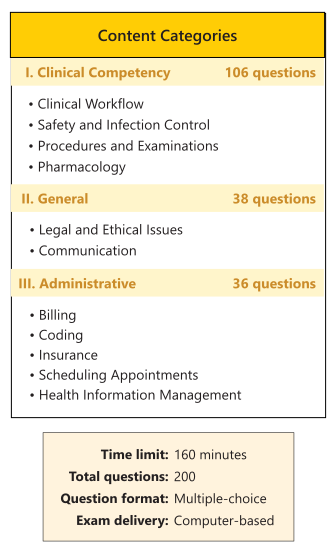
The CMA (AAMA) exam is computer-based and has a set number of questions (currently 200) with a time limit (4 hours). Pace yourself. Don’t spend too much time on any single question. If you’re stuck, flag it and move on. You can always come back to it later if time permits.
Read each question carefully. Pay attention to keywords like “most,” “least,” “best,” or “except.” Many questions test your ability to differentiate between similar concepts. Trust your knowledge, but also trust your gut. Your preparation should make this feel manageable, not overwhelming.
Post-Exam: Results and Next Steps
You’ve done it! You’ve conquered the exam. But the timeline doesn’t necessarily end when you walk out of the testing center.
Receiving Your Exam Results
Typically, you’ll receive your preliminary score report immediately after finishing the exam on the computer. This gives you an idea of your performance. Official confirmation and detailed scoring usually follow from the AAMA within a specific timeframe, often a few weeks. Be patient; the official results are what matter for credentialing.
Don’t obsess over the preliminary score if it’s borderline. Wait for the official confirmation. The AAMA uses a scaled scoring system, so raw scores don’t always tell the whole story. Official documentation is key.
What Happens If You Pass?
Congratulations! You’ll receive official notification of your passing score and information on how to access your CMA (AAMA) certificate. You can now proudly use the credential in your professional life. This is the culmination of all your hard work and planning.
Start updating your resume and professional profiles immediately. Let employers know you’ve achieved this significant milestone. This opens doors to new job opportunities and career advancement. Your timeline to become a CMA is officially complete.
If You Don’t Pass: Re-evaluation and Retaking
It happens. Not everyone passes on the first try. If you don’t pass, don’t despair. The AAMA provides information on how soon you can reapply and retake the exam. Usually, there’s a waiting period (e.g., 90 days) before you can test again. Use this time wisely.
Analyze your score report. Identify the specific areas where you performed poorly. This is Crucial feedback. Refine your study plan based on this information. Seek additional resources or study groups. Many candidates find success on their second or third attempt after a more focused review.
Factors Influencing Your Timeline
No two candidates have the exact same journey. Several factors can speed up or slow down your personal timeline.
Prior Medical Knowledge and Experience
If you have a background in healthcare or previous related certifications, you might find certain topics easier. This could potentially shorten your study period. Conversely, if you’re entering the field with little to no prior knowledge, expect to dedicate more time to learning the fundamentals.
Comfort level with medical terminology, anatomy, physiology, and common clinical procedures. A strong foundation can significantly accelerate your progress through the study phase. Experience often reinforces theoretical knowledge, making it stick better.
Program Type and Structure
The type of educational program you complete plays a major role. A fast-track certificate program might get you eligible in under a year. A two-year associate’s degree will naturally take longer. Part-time programs extend the timeline further compared to full-time immersive courses.
Consider the accreditation and curriculum of the program. A Full program that thoroughly prepares you for the CMA exam will require a significant time investment, but it’s time well spent. A shorter, less rigorous program might leave you needing much more study time later.
Personal Study Habits and Discipline
This is huge. How disciplined are you? Can you stick to a study schedule consistently? Do you learn quickly, or do you need more repetition? Your personal study habits are perhaps the most significant variable.
Some people thrive on intense, short bursts of study. Others need a slower, more consistent pace over a longer period. Be honest with yourself about what works best for you and build your timeline accordingly. Don’t compare yourself to others; focus on your own effective learning strategy.
Sample Timelines: A Realistic Look
Let’s break down some potential timelines. These are estimates, of course, and your mileage may vary.
The Accelerated Path (6-12 Months)
This timeline is aggressive. It often involves completing a 9-12 month certificate program, followed by a concentrated 2-3 month study period. This requires significant dedication and potentially juggling study with work or other commitments. It’s doable, but demands laser focus.
This path is ideal for recent graduates with strong academic backgrounds or those with considerable prior healthcare experience. They can Use existing knowledge to shorten the study phase. It requires immediate application submission post-graduation and prompt scheduling.
Source : acmso.org
The Standard Path (12-24 Months)
This is the most common route. It typically includes a 1-2 year associate’s degree program, followed by 3-6 months of dedicated CMA exam preparation. This allows for a more balanced approach to education and study, reducing burnout risk.
This timeline accommodates individuals who may need to work while studying or have family obligations. It provides a more relaxed pace for absorbing information and practicing skills. It’s a sustainable approach for many aspiring medical assistants.
The Extended Path (2+ Years)
This might involve a longer degree program, or perhaps significant time between completing education and deciding to pursue certification. It could also include individuals qualifying based on extensive on-the-job experience, requiring them to dedicate Large time to formal study after years away from academic settings.
This path isn’t necessarily worse; it just reflects different life circumstances. The key is to Make sure your knowledge stays current and your study efforts are Full, regardless of the elapsed time. A thorough review course can be particularly beneficial here.
Achieving Your Goal: Beyond the Timeline
Passing the CMA (AAMA) exam is a major accomplishment. But it’s a stepping stone, not the final destination. Think about what comes next.
Continuous Learning and Professional Development
The medical field is constantly evolving. Once certified, commit to ongoing learning. Attend workshops, pursue continuing education units (CEUs), and stay updated on best practices and new technologies. Maintaining your certification often requires this.
The knowledge you gained for the exam is just the foundation. True professionals build upon that foundation throughout their careers. This commitment ensures you provide the best possible patient care and remain a valuable asset to any healthcare team.
Career Advancement Opportunities
With your CMA (AAMA) credential, a world of opportunities opens up. You can seek positions in various healthcare settings – clinics, hospitals, private practices, specialized medical offices. It demonstrates your competence and dedication to the profession.
Don’t underestimate the power of this certification. It can lead to better job prospects, higher salaries, and opportunities for specialization or advancement into supervisory roles. It’s the recognition you deserve for your hard work and expertise.
The Bottom Line: Planning is Top
Your timeline to pass the AAMA Certified Medical Assistant exam is entirely within your control, provided you plan meticulously. From understanding eligibility to hitting the books and finally walking into that testing center, each step requires forethought. Don’t leave your success to chance. Map out your journey, stay disciplined, and celebrate each milestone along the way. It’s a challenging path, no doubt, but with a solid plan and unwavering commitment, that CMA (AAMA) credential is well within your reach. Now go get it!
Frequently Asked Questions
What is the pass rate for the AAMA exam?
It’s not super high, but definitely achievable! Historically, the pass rates hover around 70-75%. So, if you study hard, you’ve got a solid shot. Don’t sweat it too much, just prepare.
How long does the AAMA exam take?
You get a decent amount of time for the exam. It’s usually around 4 hours, which includes your time for breaks. Plenty of time to think through those tough medical assisting questions, trust me.
Is the CMA exam difficult to pass?
It can be challenging, yeah. It covers a lot of ground, from clinical skills to administrative duties. But ‘difficult’ doesn’t mean ‘impossible’. Consistent study and understanding the material is key. Don’t underestimate it, but don’t be terrified either.
How much does it cost to take the AAMA exam?
So, the exam fee itself is usually around $125. But you also gotta factor in costs for study materials, maybe practice tests, and sometimes travel if you’re not taking it locally. Budgeting is a good idea for your overall exam cost.
What happens if I fail the AAMA exam?
Don’t panic if you don’t pass the first time. You can retake it! There’s usually a waiting period, and you’ll need to reapply and pay the fee again. It’s a setback, for sure, but just use it as a chance to pinpoint what you need to improve on for your next exam attempt.
