The Real Deal: Cracking the Code on California CTEC Tax Preparer Certification
Alright, let’s cut through the noise. You wanna be a tax preparer in California? It’s not exactly rocket science, but there are definitely hoops to jump through. Forget the corporate jargon; I’m gonna break down exactly what you need to know to get that CTEC certification rolling.
Think of it this way: the IRS has its rules, and California, bless its complicated heart, has its own set of requirements layered on top. This isn’t just about filling out forms; it’s about proving you’re legit. And trust me, nobody wants to get flagged for doing taxes wrong.
So, how do you actually become a Certified Tax Preparer in the Golden State? It boils down to a few key steps. Let’s dive in, shall we?
First Things First: Do You Even Need CTEC?
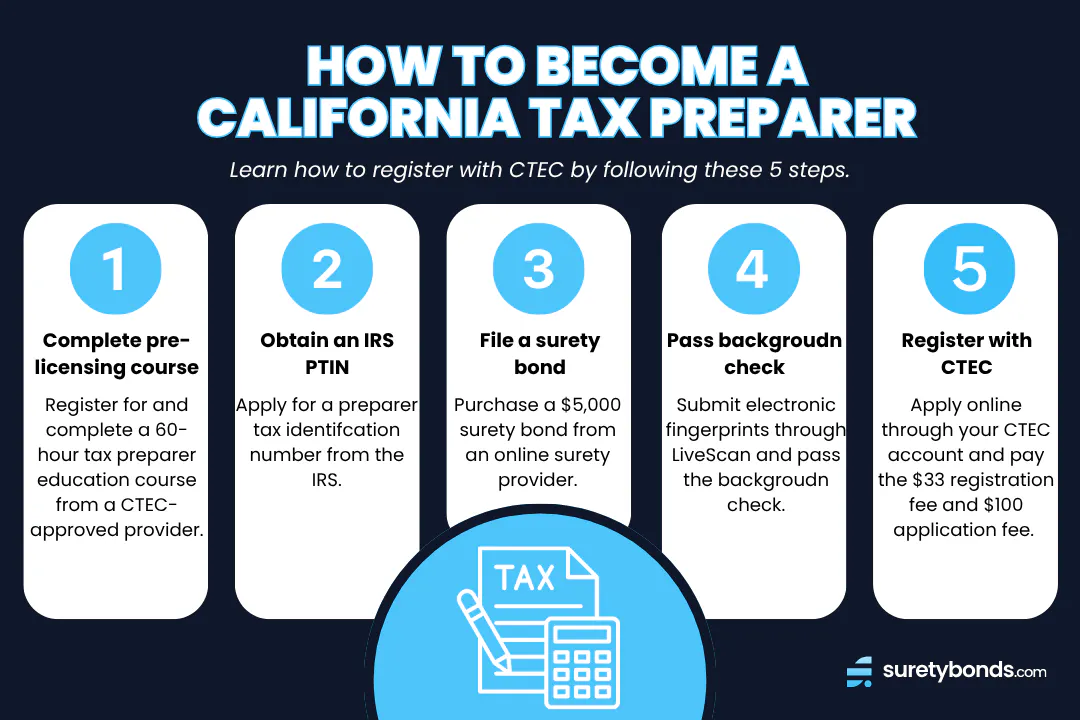
Source : suretybonds.com
This is where it gets a little tricky. Not everyone needs to be CTEC certified. Big surprise, right? California likes to keep you guessing.
Who’s Off the Hook?
If you’re already a Certified Public Accountant (CPA) or an Enrolled Agent (EA) with the IRS, you’re golden. You’ve already jumped through enough federal hoops to get a pass on the state-level stuff. Your existing credentials mean you don’t need to worry about CTEC. Easy peasy.
The Catch-All Rule
But for everyone else? If you prepare tax returns for others for a fee in California, and you’re not one of those exempted professionals, then yeah, you need to register with CTEC. It’s pretty straightforward: if you get paid to do someone’s taxes, CTEC wants to know about it.
What “For Compensation” Really Means
This is a biggie. If you’re just helping out a neighbor or a family member without taking a dime, you’re likely in the clear. But the moment payment is involved, directly or indirectly, you’re stepping into CTEC territory. Think about a business owner who prepares returns for their clients – that’s compensation, plain and simple.
The Grand Application: Getting Started with CTEC
Okay, so you’re not exempt. Time to get your hands dirty with the actual application process. It’s not a marathon, but it’s definitely a sprint with a few hurdles.
Source : latinotaxpro.com
Online Application: The Digital Gateway
The first official step is usually the online application. CTEC has a portal for this. You’ll be filling out details about yourself, your business (if you have one), and probably undergoing a background check. Make sure all your ducks are in a row before you start. Double-check everything. Seriously.
Your Personal Information is Key
They want to know who you are. This includes your name, address, social security number, and any business names you operate under. It sounds basic, but accuracy here prevents a ton of headaches down the road. Accuracy prevents headaches.
Background Checks: No Surprises Allowed
California wants to make sure you’re not a tax scofflaw. Expect them to check for criminal convictions, especially anything related to fraud or dishonesty. If you have a checkered past, it’s best to address it head-on rather than hoping they won’t notice. Be upfront about past issues.
Education: The 60-Hour Hurdle
This is probably the biggest hurdle for most aspiring tax preparers. You can’t just wing it; you need formal education. CTEC mandates a specific amount of training.
The 60-Hour Rule Explained
You’re required to complete 60 hours of qualifying tax education. This isn’t just watching YouTube videos. It needs to be from an approved CTEC provider. Think of it as a crash course in tax law and preparation techniques relevant to California. You can find information on approved providers on the official CTEC website.
What Does “Qualifying Education” Mean?
It means the coursework has to cover specific topics. This usually includes federal tax law, California state tax law, ethics, and preparer responsibilities. They want to Make sure you know the ins and outs, not just the surface-level stuff. This education is Key.
Finding an Approved Provider
Don’t just sign up for any tax course. You MUST use a provider that is specifically approved by CTEC. Many organizations offer these courses, often online for convenience. A great resource for understanding these specific requirements is Surgent’s California CTEC Requirements page. They lay out what you need to know in plain English.
Timing is Everything
There’s a catch here: you need to complete these 60 hours before you register with CTEC. You can’t just take the courses and then decide later. Get them done, get your certificate of completion, and then move forward with your registration. Education first, then registration.
The PTIN: Your Tax Preparer ID Number
This one is actually a federal requirement, but it ties directly into your California registration. It’s like your social security number for tax prep.
What is a PTIN?
PTIN stands for Preparer Tax Identification Number. If you prepare or assist in preparing federal tax returns for compensation, you’re required to have one. The IRS issues these numbers. It’s how they track tax return preparers at the federal level. Every paid preparer needs a PTIN.
How to Get Your PTIN
Applying for a PTIN is done through the IRS website. It’s a separate process from your CTEC application. You’ll need to provide identifying information, and there’s usually a small annual fee associated with it. Don’t skip this step; it’s a non-negotiable federal requirement.
Linking PTIN to CTEC
When you apply to CTEC, you’ll be asked for your PTIN. This number links your federal registration to your state registration, showing that you’re compliant on both levels. Your PTIN is your golden ticket.
The Tax Preparer Bond: Protecting the Public
This is one of those requirements that makes people scratch their heads, but it serves a purpose: consumer protection.
Why the Bond?
California requires tax preparers to carry a tax preparer bond, also known as a surety bond. This bond is a form of insurance. If you mess up and cause financial harm to a client due to negligence or fraud, the bond can be used to compensate them. It’s a safety net. This protects your clients.
Bond Amount and Provider
The required bond amount can change, but historically it’s been around $5,000. You need to obtain this bond from a surety company licensed to do business in California. Again, this is a separate step from your education and CTEC registration itself. You’ll need proof of this bond to complete your CTEC application.
![CTEC 60 Hour Qualifying Education Course [CTEC Approved]](https://cataxcourses.com/wp-content/uploads/2022/03/CTEC-60-Hour-Course.png)
Source : cataxcourses.com
Finding a Surety Company
Many insurance companies offer surety bonds. You’ll want to shop around for a reputable provider and get quotes. It’s an annual cost, so factor that into your business expenses. Shopping around saves money.
Registering with CTEC: The Final Push
You’ve done the education, you’ve got your PTIN, you’ve sorted the bond. Now, it’s time to make it official with CTEC.
Submitting Your CTEC Application
This is where you bring all the pieces together. You’ll submit your completed application form along with proof of your education, your PTIN, and your surety bond information. The application is the culmination.
Fees, Fees, Fees
Be prepared to pay fees. There’s an application fee for CTEC, and remember, there’s also the annual fee for your PTIN and the cost of your surety bond. Budgeting for these costs is Needed for any new tax preparer. Factor in all the costs.
The Waiting Game
Once submitted, you wait. CTEC will review your application. If everything is in order, they’ll approve your registration. Processing times can vary, so be patient. Check the CTEC website for current processing estimates.
What Happens After Approval?
Once approved, you’ll be a registered California Tax Preparer. Congratulations! But don’t get too comfortable. This registration is valid for a limited time, and you have ongoing obligations.
Continuing Education: Never Stop Learning
So, you got certified. Great! But guess what? The tax world doesn’t stand still. Laws change, forms get updated, and CTEC wants you to keep up.
The Annual Requirement
Every year, you need to complete 15 hours of continuing education (CE). This is different from the initial 60 hours. This is about staying current. Think of it as professional development to keep your skills sharp and your knowledge up-to-date. Staying current is key.
What Counts as CE?
Similar to the initial education, these CE courses must be from CTEC-approved providers. They typically cover federal tax law updates, California tax law changes, and ethics. Make sure the courses you choose are specifically designated for CTEC CE credit. Choose approved courses.
Ethics Training Requirement
A portion of your 15 hours (usually 2 hours) must be dedicated to ethics training. This reinforces the importance of professional conduct and integrity in the tax preparation business. It’s not just about the numbers; it’s about trust. Ethics matter immensely.
Renewal Time!
Your CTEC registration needs to be renewed annually. You’ll submit proof of your completed continuing education hours along with your renewal application and fees. Failing to meet the CE requirements or renew on time can result in penalties or even the suspension of your registration. Renew on time, every time.
A Look at the Numbers: CTEC Requirements at a Glance
Let’s put some of the key numbers and requirements into a format that’s easy to digest. This table should give you a quick snapshot of what you’re up against.
| Requirement Category | Initial Certification | Annual Renewal | Notes |
|---|---|---|---|
| Qualifying Education | 60 Hours | /A (Continuing Ed applies) | Must be from CTEC-approved provider. Includes tax law, ethics. |
| Continuing Education (CE) | /A | 15 Hours | Must be from CTEC-approved provider. Includes 2 hours ethics. |
| PTIN | Required | Required Annually | Federal requirement from IRS. |
| Tax Preparer Bond | Required | Required Annually | Typically $5,000. From a licensed surety company. |
| CTEC Application/Renewal | One-time (initial) | Annual | Includes fees. |
| Background Check | Yes (initial) | Periodic/As needed | For criminal history/fraud. |
Common Pitfalls to Avoid
You’ve seen the requirements, but what trips people up? It’s usually the little things, or a misunderstanding of the process. Let’s sidestep those traps.

Source : suretybonds.com
Using Unapproved Education Providers
I cannot stress this enough: stick to CTEC-approved education. Signing up for a random online tax course might feel cheap, but if it’s not on CTEC’s list, your hours won’t count. You’ll have to re-do it. Waste of time and money. Always verify provider approval.
Missing Renewal Deadlines
The annual renewal isn’t optional. If you miss the deadline, your registration can lapse. This means you can’t legally prepare taxes until you’re re-registered, which might involve starting the process over. Keep a calendar alert. Deadlines are non-negotiable.
Forgetting the PTIN or Bond
These are often overlooked because they seem separate from CTEC. But they are integral parts of your legal standing as a tax preparer in California. Missing either one means your CTEC application will be incomplete, or your renewal will fail. Don’t neglect federal or bond requirements.
Incomplete or Inaccurate Application
Typos, missing information, or falsified details can get your application rejected outright. Take your time. Double-check every box. If you’re unsure about something, contact CTEC directly before submitting. Accuracy is Top.
The Bottom Line: Is It Worth It?
Getting CTEC certified isn’t exactly a walk in the park. It takes time, effort, and a bit of cash. You’ve got the education, the bonding, the annual renewals. It’s a commitment.
Building Trust and Credibility
But here’s the flip side: going through this process legitimately builds trust. Clients know you’ve met state standards. It separates you from the fly-by-night operations. Credibility matters.
A Legitimate Income Stream
If you’re serious about making tax preparation a career or a solid side hustle, the requirements are there for a reason. They Make sure a level of professionalism in the industry. Following the rules means you can operate legally and confidently. Operate legally.
Stay Informed
The world of taxes is always shifting. Keep your eyes open for changes in legislation and CTEC’s own rules. The Surgent page and the CTEC site are your friends here. Staying informed is part of the job. Knowledge is power.
Frequently Asked Questions
What is CTEC and why is it important for tax preparers in California?
Because CTEC stands for the California Tax Education Council. It’s basically the state’s way of making sure folks who prepare taxes for a living actually know their stuff. If you waa prepare tax returns for others in California, you gotta get registered with them. It’s all about protecting taxpayers and making sure everyone’s playing by the rules. You need to complete their education requirements to even get your California tax preparer number.
What are the initial education requirements to become a CTEC-registered tax preparer?
So, when you’re first starting out, you gotta knock out 60 hours of qualifying education from a CTEC-approved provider. This covers the basics of federal and state income tax law. Think of it as your crash course. After that, you’ll need to pass a final exam for that course. It’s pretty Key to get this done right so you’re set up for your initial tax preparer registration.
Is there an aual continuing education requirement after initial certification?
Oh yeah, absolutely. Once you’re in, you’re not done. Every year, you need to complete 15 hours of continuing education. This keeps your skills sharp and makes sure you’re up-to-date with all the crazy changes in tax laws. It’s a mix of federal and state topics. Don’t skip it, or your registration will lapse. Gotta keep that CTEC continuing education up!
What’s the process for renewing my CTEC registration each year?
Basically, after you finish your 15 hours of continuing education, you’ll get a certificate of completion from your education provider. You then take that, file your tax preparer bond, get your business license (if you need one), and then you submit your renewal application and fee to CTEC. It’s an aual thing, so mark your calendar! Making sure your tax preparer renewal is smooth is key.
Are there any specific background check or ethical requirements for CTEC tax preparers?
Yeah, CTEC does want to make sure you’re not a risk. You’ll need to disclose any criminal convictions on your application, and they can deny registration if you have certain ones. Plus, you gotta agree to follow their code of ethics, which includes things like confidentiality and not misleading clients. It’s all part of building trust and making sure people feel good about who they’re hiring to do their taxes. Keeping that ethical tax preparer standard is a big deal.
