Gender Predictor Chinese Calendar 2026
The 2026 Chinese Gender Calendar: Your Crystal Ball for Baby’s Sex?
So, you’re pregnant and the guessing game has officially begun, right? Everyone’s asking, “Do you know if it’s a boy or a girl yet?” It’s natural to be curious, and honestly, it’s kind of fun to try and guess. For centuries, people have turned to ancient methods to get a peek into the future. One of the most talked-about is the Chinese Gender Predictor Calendar. You’ve probably seen charts floating around, promising to tell you everything. But does this old-school tool actually hold up in 2026? Let’s dig into it.

Source : prokerala.com
This isn’t some new fad; the legend goes that this predictor’s roots are super old, maybe even from the Qing Dynasty. Imagine a bunch of scholars, monks, or maybe just curious folks back then, trying to figure out the sex of a baby based on… well, what? It’s a fascinating thought. They supposedly kept meticulous records, linking the mother’s age and the lunar month of conception to the baby’s sex. Crazy, huh?
Fast forward to today, and we’ve got sleek apps and websites showing these charts. The Chinese Gender Predictor 2026 is everywhere, promising answers. It’s built on two main pieces of info: your age (your lunar age, mind you, which is a whole other can of worms) and the month you got pregnant (again, according to the lunar calendar). Plug those in, and BAM! The chart spits out a prediction. Boy or girl? Easy peasy.
How Does This Thing Actually Work? The Nitty-Gritty.
Alright, let’s break down the mechanics. It’s not rocket science, but you do have to get your head around the lunar calendar stuff. First up: Mother’s Lunar Age. This isn’t just your birthday. In Chinese tradition, you’re considered one year old when you’re born. Plus, a whole year is added on New Year’s Day. So, if you were born in December 1990, by Chinese reckoning, you might already be two years old when the year ends. Confusing? A bit. But crucial for the predictor. You need to know your lunar age during the month of conception.
Next: Month of Conception. Again, we’re not talking about your standard Gregorian calendar here. This is all about the Chinese lunar calendar. The months are different, shorter, and sometimes have leap months. So, figuring out which lunar month you conceived in can be tricky. Most online tools will help you convert your conception date, but it’s good to know the principle: the predictor pairs your lunar age with the specific lunar month of conception. Think of it like a giant, ancient spreadsheet.
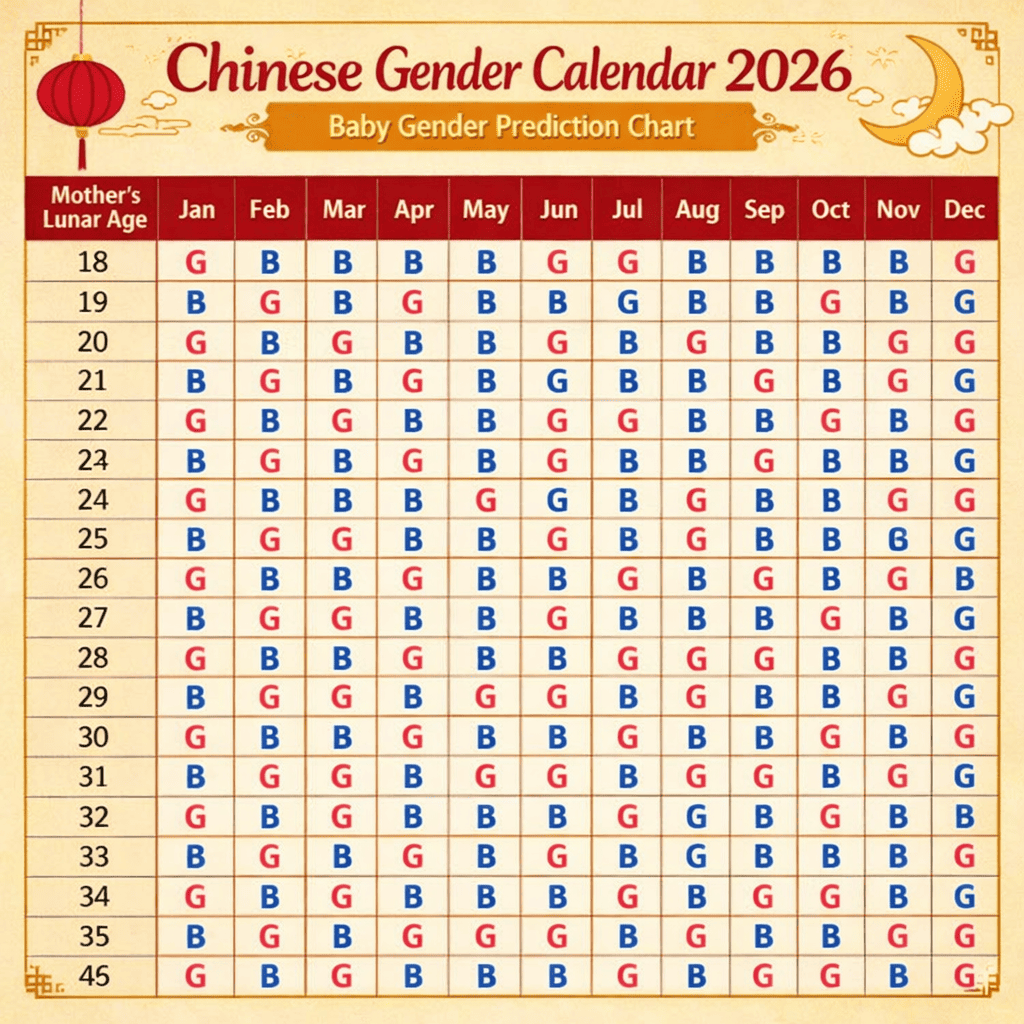
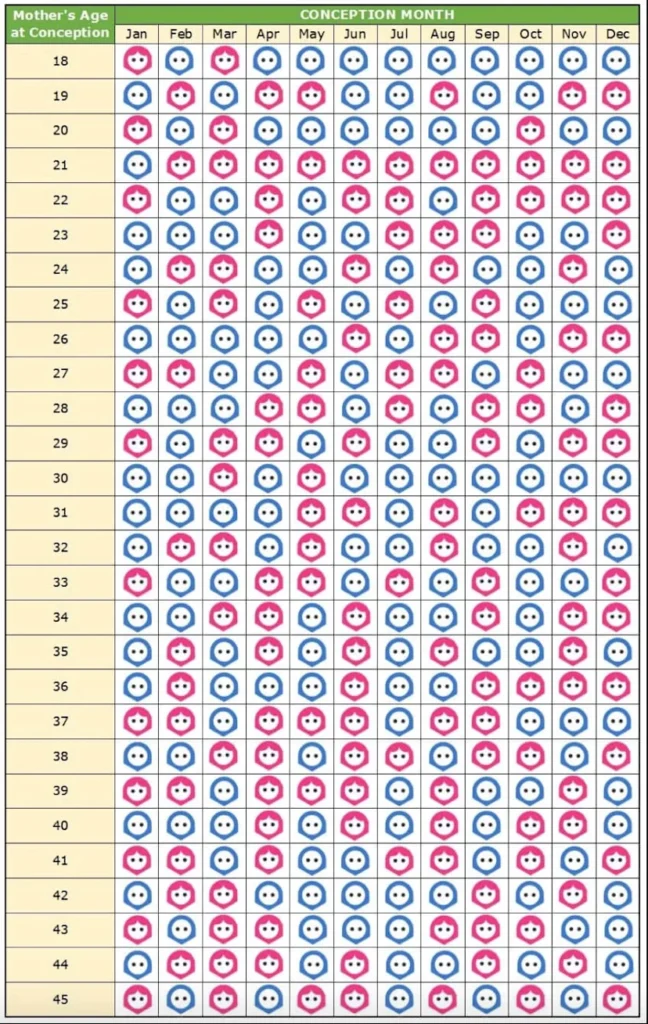
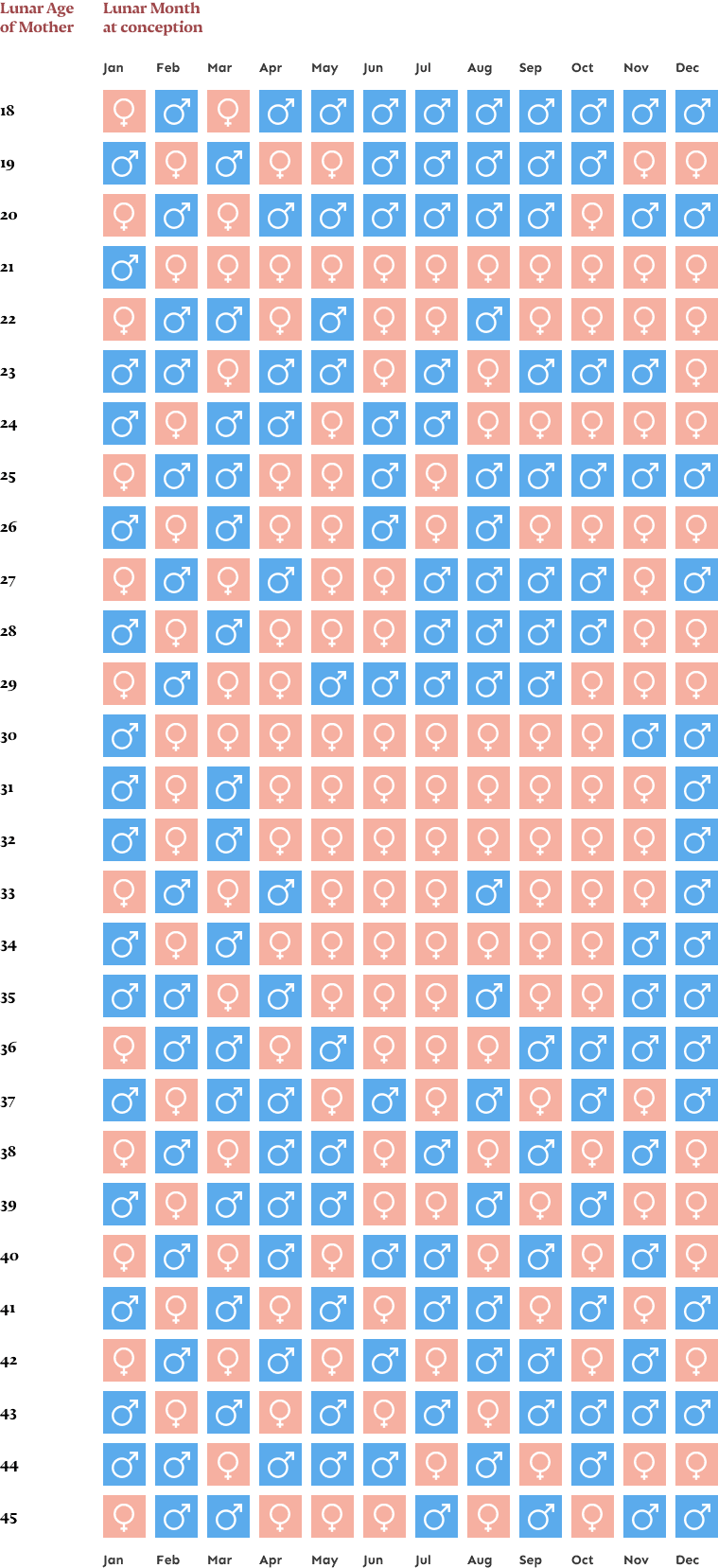
Once you have both numbers, you find where they intersect on the chart. Simple, right? One side lists the lunar months, the other lists the lunar ages. Where they meet? That’s your prediction. A little ‘B’ for boy, a little ‘G’ for girl. Some charts might be more detailed, showing probabilities, but the core idea is this grid lookup. It’s a fun system, no doubt.
Is The Chinese Gender Predictor Calendar 2026 Actually Accurate? Let’s Be Real.
This is the million-dollar question, isn’t it? Does it really work? The short answer? It’s a maybe, leaning towards ‘not really.’ Look, people have been using this for ages, and sure, some predictions are spot-on. My cousin swore by it, and bam, she had a boy. My neighbor tried it, and it said girl, and guess what? Yep, a girl. Coincidence? Maybe. Or maybe there’s something to it.
But here’s the kicker: scientific studies? They don’t really back it up. Most modern research suggests that conception is largely a matter of biology and timing. The odds of conceiving a boy or a girl are pretty close to 50/50, regardless of the lunar calendar. Some studies might show a slight edge for the predictor, but it’s usually within the margin of error. So, while it’s a fun prediction tool, don’t bet your life savings on it.
Source : lingoace.com
Think about it: the original chart was supposedly based on records from a specific time and place. Does it still apply universally today? And the conversion between lunar and Gregorian calendars? It can get messy. Plus, the lunar age calculation? It’s not as straightforward as just adding a year. So, while it’s a cool piece of history and a great conversation starter, relying on it solely for your baby’s sex prediction might lead to disappointment. It’s more for entertainment than a definitive answer.
The History Behind the Magic (or Lack Thereof)
Where did this whole Chinese Gender Predictor thing even come from? The stories are fuzzy, which, you know, happens with stuff that’s super old. The most popular tale points to a chart found in a royal tomb near Beijing, dating back maybe 700 years. It was supposedly used by empresses and royalty to choose the gender of their heirs. Sounds dramatic, right? Like something out of a historical drama.
Other theories suggest it was developed by Chinese astronomers or astrologers. They were super into tracking celestial bodies and natural cycles. It’s plausible they’d try to link these cycles to human reproduction. This was a time when understanding biology wasn’t like it is today. People looked for patterns everywhere. The lunar cycles were HUGE back then, influencing everything from farming to festivals. It makes sense they’d coect them to childbirth.
Regardless of the exact origin, the chart became a popular tool. It spread through families, passed down through generations. It’s a piece of cultural heritage. Even if its predictive power is questionable, its cultural significance is undeniable. It represents a historical attempt to understand and perhaps even control something as mysterious as conception. A fascinating cultural artifact, for sure.
So, Should You Use the Gender Predictor Chinese Calendar 2026?
Look, I’m not going to tell you not to use it. It’s fun! It’s a game. Think of it like reading your horoscope or playing with those fun quizzes on social media. If you want to have a little bit of extra excitement while you wait for the real answer (hello, 20-week ultrasound!), go for it. Plug in your lunar age and conception month. See what the 2026 gender predictor says. Share it with your friends, giggle about it.
But here’s the advice from someone who’s seen it all: don’t get too attached to the result. If it says ‘boy’ and you’ve always dreamed of a daughter, try not to let that possibility overshadow your excitement. The real confirmation will come from your doctor. An ultrasound is the most reliable way to find out. Some couples even prefer the surprise on delivery day! That’s a whole other level of fun.
Ultimately, the Chinese Gender Predictor Calendar is a cultural curiosity and a lighthearted way to engage with your pregnancy. Enjoy the process, embrace the mystery, and remember that the most important thing is a healthy baby, regardless of gender. For a more mystical peek, you can explore predictions on sites like MPanchang’s predictor, but always take it with a grain of salt.
What About Accuracy? Let’s Be Blunt.
Okay, let’s circle back to accuracy because I know that’s what’s really on your mind. The truth? It’s a crapshoot. Seriously. Imagine flipping a coin. You’ve got a 50% chance of getting heads (boy) and a 50% chance of getting tails (girl). The Chinese Gender Calendar? It operates on pretty much the same principle. There’s no real science behind it that holds up under scrutiny. It’s an old wives’ tale, dressed up in a lunar calendar.
Some folks will tell you, “Oh, it was right for me!” And you know what? It’s right about 50% of the time for everyone, by pure chance. That’s statistics for you. If you ask 100 people, about 50 will get a correct guess. But that doesn’t mean the calendar caused the correct guess. It’s like saying your lucky socks helped you win the lottery; you probably would have won anyway. It’s just a fun guessing game.
So, while you’ll find tons of articles and websites claiming all sorts of accuracy rates (some even pushing 90%!), take those numbers with a massive dose of skepticism. They’re often based on self-reported data or cherry-picked examples. For a reliable answer, you need medical technology, not ancient folklore. Don’t base any big decisions on this predictor; just use it for kicks.
How to Use the 2026 Chinese Gender Predictor Correctly (If You Must)
If you’re determined to give this ancient predictor a whirl, you gotta do it right. Otherwise, what’s the point? First things first: understand the lunar calendar. This is key. You can’t just use your regular birthday and conception date. You need your Chinese lunar age when you conceived and the Chinese lunar month of conception. There are plenty of online converters for this. Just search “Chinese lunar calendar converter.” Be warned, they can be a bit fiddly.
You’ll need your exact birth date (including the year, obviously) and the approximate date you conceived. The converter will spit out your lunar birth date and the corresponding lunar month of conception. Remember, the Chinese New Year changes every year, so using a tool that’s up-to-date for 2026 is important. Accuracy here is… well, as accurate as the conversion tool allows, which isn’t exactly scientific precision.
Source : calendarchinese.com
Once you have your lunar age and lunar conception month, find a Chinese Gender Predictor Chart for 2026. You can find these easily online. They’re usually grids. Find your lunar age on one axis and your lunar conception month on the other. The intersection point tells you the predicted gender. Easy enough, right? Just remember what I said about accuracy. Treat it like a game.
The Lunar Age Calculation: It’s Not What You Think
This is where things get a little weird for Western brains. The Chinese lunar age system is different. You’re not born zero years old. Nope. You’re born one year old. Happy birthday! Then, when the Chinese New Year hits, everyone gets a year older, no matter when their birthday actually falls. So, if you were born on December 31st, 2000, you’d be considered 1 year old at birth. Then, on January 1st, 2001 (Chinese New Year), you’d instantly turn 2. It’s a different way of counting time, deeply ingrained in their culture.
So, to use the predictor, you need to figure out your lunar age at the time of conception. This means you need your Gregorian birth date, convert it to a lunar birth date, and then determine how many Chinese New Years have passed between your lunar birth date and your conception date. Add one for the initial year of life. It’s complicated. That’s why most people just use an online calculator. Trying to do it manually is a recipe for headaches. This whole lunar age system is a major hurdle for many.
Why the difference? It stems from historical and cultural reasons. It emphasizes the time spent in the womb as part of one’s life. It also ties into the cyclical nature of time in Chinese philosophy. While it seems confusing to us, it’s a logical system within its own cultural context. Just know that getting this number right is crucial if you’re going to rely on the predictor at all.
The Lunar Conception Month: Don’t Mess This Up!
Just like the lunar age, the month of conception needs to be on the lunar calendar. The Chinese lunar calendar doesn’t have 30 or 31 days like ours. Its months are based on the moon’s phases, so they’re usually 29 or 30 days long. Plus, they sometimes add a ‘leap month’ to keep things synced up with the solar year. This means a specific date in our calendar might fall into a different lunar month depending on the year.
So, if you conceived on, say, April 15th, 2025, you can’t just look at ‘April’ on the chart. You need to know which lunar month that date corresponds to in 2025. Again, online converters are your best friend here. Input your conception date, and it should tell you the corresponding lunar month. Getting this right is just as important as the age calculation. One wrong input, and your prediction is toast.
This is why many modern gender predictor tools online are so popular. They do all this complex conversion work for you. You just enter your Gregorian birth date and conception date, and they handle the lunar calculations. It simplifies the process immensely, allowing you to focus on the fun part: guessing. Just make sure you’re using a reputable site that’s updated for the current year, like RforRabbit’s predictor.
Debunking the Myths: What Science Actually Says
Let’s get down to brass tacks. The Chinese Gender Predictor is a cultural artifact, a piece of folklore. It’s not science. Period. While it’s fun to engage with history and tradition, expecting medical-grade accuracy from it is unrealistic. The scientific consensus? It’s about 50/50 odds, just like flipping a coin.
The primary method for determining a baby’s sex with high accuracy is through medical procedures like ultrasounds or genetic testing (like NIPT). These methods look directly at the chromosomes or physical development. The Chinese calendar relies on correlations that haven’t been proven to have any causal link to a baby’s sex. It’s fascinating anthropology, but not biology.
So, while you might see anecdotal evidence or personal stories of its success, remember that confirmation bias is a powerful thing. People tend to remember the times it was right and forget the times it was wrong. Don’t let the ancient gender chart influence your expectations too much. Enjoy it for the game it is, but trust your doctor for the facts.
Is It Safe to Use the Gender Predictor?
Safe? Absolutely. Using the Chinese Gender Predictor Calendar involves nothing more than looking at a chart and maybe doing some quick date conversions online. There are no chemicals, no procedures, nothing invasive. It’s about as safe as it gets. You can’t harm yourself or your baby by consulting an old chart.
The only potential ‘risk,’ if you can even call it that, is emotional. If you get your heart set on a specific gender based on the predictor’s guess, and then the reality is different, you might feel a pang of disappointment. But again, that’s manageable if you keep perspective. It’s a prediction, not a guarantee.
Source : baby-chick.com
So, yes, go ahead and use it! Have fun with it. It’s a harmless way to add a little extra anticipation to your pregnancy journey. Just don’t take the results as gospel. The gender predictor is for entertainment purposes only.
What About Other Gender Predictors?
The Chinese calendar isn’t the only game in town. There are tons of other fun, folklore-based methods people use. You’ve got the ‘ring test’ (swinging your wedding ring over your belly), the ‘cabbage test’ (mixing red and white cabbage with urine – ew!), and even things like how you’re carrying the baby (high or low). Each has its own set of supposed rules and anecdotal evidence.
Like the Chinese calendar, none of these have any real scientific backing. They’re all based on tradition, superstition, and observations that are likely coincidental. They make for great baby shower games or conversations with friends, but again, don’t rely on them for a definitive answer. The old wives’ tales are charming, but that’s about it.
Modern medicine offers reliable methods. Ultrasounds around 18-20 weeks are pretty accurate. Non-Invasive Prenatal Testing (NIPT), which analyzes fetal DNA in the mother’s blood, can detect sex chromosomes much earlier, often around 10 weeks. These are the methods to trust if you need a concrete answer. The other predictors? Purely for fun. Keep that in mind when you’re looking at the Chinese Gender Predictor.
The Verdict on the Chinese Gender Predictor Calendar 2026
So, we’ve chewed the fat about the 2026 Chinese Gender Predictor. What’s the final word? It’s a fascinating piece of cultural history and a really fun way to engage with your pregnancy. It taps into that primal human curiosity about the future. Does it accurately predict your baby’s sex? Honestly, probably not with any reliable consistency. The science just isn’t there.
Think of it as a predictor, not a definitive statement. Use it for conversation, for fun at baby showers, or just to satisfy your own curiosity. But when you want the real answer, the one you can count on, stick to your doctor’s appointments. That ultrasound is your best bet. And hey, maybe the surprise of finding out when the baby arrives is the best prediction of all!
At the end of the day, whether the chart says boy or girl, the most important outcome is a healthy baby. That’s the real prize. So, have fun with the Chinese Gender Calendar, but don’t let it stress you out. Embrace the guessing game, but wait for the real confirmation from your healthcare provider. It’s all part of the amazing journey of pregnancy.
Frequently Asked Questions
-
What exactly is the Chinese Gender Predictor Calendar for 2026?
The Chinese Gender Predictor Calendar 2026 is an ancient chart, supposedly dating back centuries, that claims to predict a baby’s sex based on the mother’s lunar age at conception and the lunar month of conception. It’s a grid system where these two factors intersect to give a prediction of boy or girl.
-
How do I calculate my lunar age and conception month for the predictor?
Calculating your lunar age and conception month involves using the Chinese lunar calendar, which differs from the Gregorian calendar. You’re considered one year old at birth, and everyone ages a year on Chinese New Year. Online converters are the easiest way to figure out your lunar birth date and the lunar month you conceived. You’ll need your exact birth date and estimated conception date.
-
Is the Chinese Gender Predictor Calendar accurate?
Honestly? Not really, according to science. While many people report it being correct for them, statistically, it’s about as accurate as flipping a coin (a 50/50 chance). Numerous studies haven’t found a reliable link between the chart’s factors and a baby’s sex. It’s fun folklore, but not a scientific tool for prediction.
-
Should I rely on the Chinese Gender Predictor for my baby's sex?
You should definitely not rely solely on the Chinese Gender Predictor for definitive answers. It’s a fun, lighthearted tool and a great conversation starter during pregnancy. However, for accurate determination, ultrasounds (around 18-20 weeks) or non-invasive prenatal testing (NIPT) are the medically reliable methods. Enjoy the predictor as a game!
-
Where can I find a 2026 Chinese Gender Predictor chart?
You can easily find 2026 Chinese Gender Predictor charts online by searching for ‘Chinese Gender Predictor Chart 2026’. Many websites offer interactive tools where you input your details, and they provide the prediction. Reputable sites like MPanchang or RforRabbit often have these calculators available.