How Long Does Epic Certification Training Program Take? The Real Scoop.
So, you’re looking into getting Epic certified, huh? Thinking about diving headfirst into the world’s most popular electronic health record (EHR) system. Good move. But the big question looming, the one that probably got you here, is just how much time are we actually talking about? Is it a weekend workshop? A semester-long grind? The truth? It’s a bit of a moving target, and anyone who tells you it’s a simple one-size-fits-all answer is probably selling you something.
I’ve seen folks dive into this expecting a quick win, only to get bogged down. Others underestimate the commitment and then scramble. Let’s cut through the noise. This isn’t just about clicking through modules; it’s about mastering a complex system that literally touches patient lives. So, yeah, the time commitment is a serious consideration.
The Big Picture: What Does “Epic Certified” Even Mean?

Source : blog.thehcigroup.com
Beyond the Buzzword: Defining Certification
First off, let’s get clear on what we mean by “Epic certified.” It’s not like getting a driver’s license where you pass one test and you’re done. Epic offers certification for specific modules – think of them as specialized skill sets within the giant Epic ecosystem. You could be certified in EpicCare Ambulatory, or maybe Radiant for radiology, or Cogito for analytics. Each one is its own beast.
It’s Key to understand that different roles require different certifications. A physician might need certification in a clinical module, while a billing specialist needs one for the revenue cycle. Don’t just aim for “Epic certified”; aim for the right Epic certification for your career path.
Why Bother with Certification? The Payoff
Okay, so it takes time. Why invest it? Simple. Epic certified professionals are in high demand. Healthcare organizations are desperate for people who know their way around this system. It often translates to better job prospects and, let’s be honest, a fatter paycheck. Think of the guy running a pizza shop on 4th Street – he knows his ovens. You’ll know your EHR.
Employers see that certification badge as a stamp of approval. It means you’ve passed rigorous testing and demonstrated proficiency. This significantly reduces their training burden and the risk of errors, making you a more valuable hire right out of the gate. It’s a tangible proof point of your skills.
The Many Paths to Certification
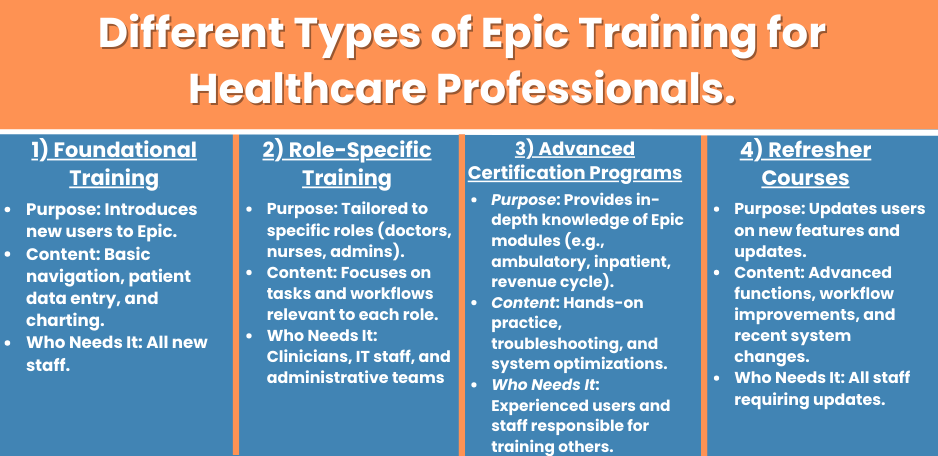
There isn’t just one way to get there. Some health systems will train their own employees. Others work with third-party training providers. And then there’s the route for independent consultants, which can be a whole different ballgame. Each path has its own timeline and requirements, which we’ll get into.
Understanding these different routes is key to managing your expectations. You can’t just sign up for an Epic course online like you would for a cooking class. It’s usually tied to employment or a specific project. This means the timing is often dictated by others.

Source : healthcareitskills.com
The Direct Route: Employee-Sponsored Training
When Your Employer Picks Up the Tab (and the Schedule)
This is probably the most common way people get trained. Your hospital or clinic decides they need you to be Epic certified in, say, Epic’s MyChart module. They send you to training, often held at their facility or a designated training center. This is typically part of your onboarding or a specific role requirement.
The upside? Usually, your salary continues, and they cover all the costs. The downside? You have zero control over the training schedule. It happens when the organization needs it, not necessarily when it’s convenient for you. Sometimes this can be intense, full-time immersion.
The Typical Timeline for Internal Training
For many core clinical modules (like EpicCare Ambulatory or Stork for OB/GYN), expect an initial intensive training period. This can range anywhere from two to six weeks, often full-time, Monday through Friday. It’s a deep dive, covering everything from basic navigation to advanced workflows specific to your role.
Following this initial boot camp, there’s often a period of “at-the-elbow” support where you shadow experienced users or are shadowed yourself. Then comes the actual certification exam. This entire process, from start to finish for a single module, might take anywhere from one to three months when you factor in the post-training ramp-up.
Module Specialization and Extended Training
What if you need certification in multiple, highly specialized modules? This is where the timeline can really stretch. For instance, someone needing proficiency in both a clinical module and a reporting module like Cogito might undergo sequential training. Each new module adds weeks, if not months, to your overall training journey.
These advanced or niche areas might require more prerequisite knowledge or a longer learning curve. For example, training for roles in Epic’s Bridges interface engine or its clinical decision support tools could involve longer, more complex programs than a standard clinician’s module. It’s not uncommon for specialized Epic training to take longer.
The Consultant’s Path: Faster, but More Intense
When Time is Money: Epic Consulting
If you’re looking to become an independent Epic consultant or work for a specialized firm, the timeline can feel compressed, but the pressure is immense. Consultants often need to get certified fast to meet client demands. Think project deadlines and billable hours.
This route usually involves more self-directed learning combined with intensive, short-term courses. It’s sink or swim, and success hinges on your ability to absorb information quickly and apply it under pressure. The pace is relentless.
Intensive Boot Camps and Accelerated Programs
Third-party providers and consulting firms often run accelerated training programs. These might condense the material you’d get over weeks into just a few days or a couple of intense weeks. You’re expected to come in with a foundational understanding and leave with a working knowledge and the ability to pass the exam.
For example, a company like HealthTECH Resources Inc. specializes in Epic consulting and training. Their approach often focuses on getting professionals job-ready quickly. This means programs can be highly focused, sometimes lasting just one to four weeks for a specific certification, followed immediately by exam attempts.
This is where you can find courses designed to get you certified in modules like EpicCadence or EpicPrelude relatively quickly. The key is that these programs are often designed for people who already have some healthcare IT background. It’s not usually for complete beginners.
The Certification Exam Itself: A Hurdle
Regardless of the training path, the final hurdle is the certification exam. These aren’t multiple-choice quizzes. They are often Full, hands-on tests that require you to demonstrate your skills in a simulated environment. Failing means you might have to wait a period before retaking, adding to the overall time.
The preparation for this exam is critical. Many programs dedicate significant time within the training period just for exam review and practice. Getting that passing score is the ultimate goal and dictates the end of the training timeline for you personally.
Factors That Flex the Timeline
Your Prior Experience Matters – A Lot
Are you coming into this with years of experience using EHRs, even if not Epic? Or are you starting from scratch? Someone who’s already a super-user of Cerner or a similar system will likely pick up Epic concepts much faster than a clinician who’s only ever used paper charts. Your existing knowledge base is a huge accelerator.
Likewise, if you have a strong IT background, understanding the technical underpinnings of Epic might be easier. This foundational knowledge can shave significant time off the learning curve. Don’t underestimate how much your past experience plays a role.

Source : certmage.com
The Specific Epic Module You’re Targeting
As we’ve touched on, not all modules are created equal in complexity. Getting certified in Epic’s Patient Registration (Resolute) is generally quicker than becoming an expert in Epic’s Cogito data warehousing and analytics suite. Some modules are designed for broader use, others for deep specialization.
Think of it like learning a language. Learning basic conversational Spanish might take a few weeks of focused study. Becoming fluent and able to write poetry? That takes years. Similarly, basic proficiency in an Epic module might be achievable relatively quickly, but true expertise, the kind that warrants certification, takes longer. A good resource for understanding module intricacies can be found at bestaccreditedcolleges.org.
Training Provider Quality and Structure
Not all training is created equal. A well-structured program with experienced instructors, good materials, and Plenty of practice time will be more efficient than a poorly organized one. The best programs are designed to maximize learning within the allotted time.
Look for programs that offer hands-on exercises, real-world scenarios, and dedicated Q&A sessions. The difference in learning outcomes—and therefore the effective time it takes to get certified—can be Large. A disorganized course could make a two-week training feel like a month.
Your Personal Learning Style and Dedication
How quickly you learn is up to you. Are you someone who can buckle down and focus for hours on end? Do you actively seek out information and ask clarifying questions? Your personal drive and learning style play a massive role. Some people thrive in immersive environments; others need time to process.
If you’re treating it like a hobby, it’ll take longer. If you’re treating it like the career-defining step it is, you’ll likely absorb the information faster. Your dedication to learning is a critical, yet often overlooked, factor in how long it takes.
Common Epic Modules and Their Estimated Timelines
EpicCare Ambulatory: The Workhorse
This is arguably the most widely used module, serving outpatient clinics and physician practices. Training here focuses on scheduling, registration, clinical documentation, and charge capture for ambulatory settings. It’s a foundational module for many.
For EpicCare Ambulatory certification, expect an intensive training period typically ranging from three to five weeks of full-time study. This is usually followed by a period of on-the-job application before the official certification exam is taken.
Epic Radiant: For the Imaging Specialists
Radiant handles radiology workflows, from scheduling imaging exams to reporting results. It involves understanding imaging orders, CVIS (Cardiovascular Information System) features, RIS (Radiology Information System) integration, and billing aspects specific to radiology.
The complexity here means certification often takes a bit longer. Training for Epic Radiant certification can realistically span four to six weeks of dedicated instruction and practice. It’s a specialized area that requires a deep dive.
Epic Resolute: Billing and Revenue Cycle Management
This module covers the financial side of healthcare – patient billing, claims processing, and revenue cycle management. It’s Key for keeping the hospital’s finances healthy. It’s intricate and rules-based.
Certification in Resolute (which can be broken down further into specific billing areas like Hospital Billing or Professional Billing) typically requires a similar commitment to clinical modules, often in the three to six-week range. Understanding payer rules and government regulations is key here.
Epic Cogito: The Data Analytics Powerhouse
Cogito is Epic’s suite for data analytics and reporting. This is for the number crunchers, the analysts, and those who want to glean insights from the vast amounts of data within Epic. It’s highly technical.
Certifications within the Cogito suite (like Chronicles, Caboodle, or Reporting Workbench) can vary widely but are generally on the longer side due to their technical nature. Expect training periods that can extend from six weeks to several months for advanced roles. This is where deep technical skills are developed.
The Certification Exam: Not a Cakewalk
What to Expect on Exam Day
Forget simple multiple-choice tests. Epic certification exams are notoriously challenging. They often involve simulating real-world scenarios where you have to perform specific tasks within the Epic system correctly. You might need to navigate patient charts, schedule appointments, enter orders, or generate reports based on given instructions.
The pressure is real. You’re often working against the clock, and every click, every decision, matters. It’s designed to test your practical application of knowledge, not just rote memorization. You’ll be using the actual Epic software interface during the test.
Source : virtelligence.com
Passing Scores and Retake Policies
While Epic doesn’t publicize exact passing percentages for all exams, it’s understood that they are rigorous. You need to demonstrate a high level of competency. If you don’t pass on your first attempt, don’t panic – it happens. However, there are usually waiting periods before you can retake the exam.
This waiting period can add weeks or even months to your overall journey to becoming certified. For example, you might have to wait 30 days after a failed attempt before you can try again. It’s another reason why thorough preparation is absolutely Top.
Maintaining Your Certification
Here’s a kicker: Epic certification isn’t a lifetime achievement. The software is constantly updated. To maintain your status, you typically need to complete ongoing education or recertification requirements periodically. This usually involves attending update training sessions or passing shorter delta exams.
These requirements are usually annual or biennial. So, while the initial training is a significant time investment, remember that staying certified requires continuous learning. It’s a commitment, not a one-and-done deal.
Sample Timelines: Putting It All Together
Scenario 1: The New Hospital Employee (Clinical Focus)
Sarah, a newly hired nurse at a large hospital system. Her employer sponsors her training. She undergoes four weeks of intensive, full-time training for EpicCare Ambulatory. After training, she spends two weeks shadowing experienced nurses and getting comfortable with live patient data. She then takes and passes her certification exam. Total time: Approximately 6 weeks to become certified and fully integrated.
Scenario 2: The Experienced Healthcare IT Consultant
John is an IT professional moving into Epic consulting. He has prior EHR experience. He enrolls in an accelerated, two-week certification course for Epic Resolute Hospital Billing provided by a third-party vendor. He spends an additional week intensely studying and practicing for the exam. He passes on his first try. Total time: Approximately 3 weeks from course start to certification.
Scenario 3: The Specialist Data Analyst
Maria is already an analyst within a health system and is being trained for a specialized role in Epic Cogito reporting. Her organization enrolls her in a program that involves eight weeks of classroom and hands-on learning, spread part-time over three months to accommodate her existing duties. She then needs an additional month to prepare for and pass the complex Cogito exam. Total time: Approximately 4 months.
A Quick Comparison Table
Here’s a simplified look at how different paths might stack up:
| Scenario | Module Focus | Training Duration | Post-Training Prep & Exam | Estimated Total Time |
|---|---|---|---|---|
| New Hospital Employee | EpicCare Ambulatory | 3-5 Weeks (Full-Time) | 2-3 Weeks | 5-8 Weeks |
| Experienced Consultant | Epic Resolute (HB) | 1-2 Weeks (Intensive) | 1 Week | 2-3 Weeks |
| Specialized Analyst | Epic Cogito (Reporting) | 6-10 Weeks (Part-Time/Blended) | 3-4 Weeks | 3-4 Months |
| Advanced Clinical User | Epic Guide (Oncology) | 4-6 Weeks (Full-Time) | 2-3 Weeks | 6-9 Weeks |
| Epic Bridges (Interfaces) | Specialized Technical | 5-7 Weeks (Full-Time) | 2-3 Weeks | 7-10 Weeks |
Managing Expectations and Planning Your Journey
Don’t Underestimate the Commitment
Look, the shortest timelines we’re talking about are still measured in weeks, not days. And that’s for focused, often prerequisite-heavy training. If you’re new to healthcare IT or aiming for a more complex module, you could easily be looking at several months. Be realistic about the time investment required.
Trying to rush the process or get certified in a module you’re not genuinely prepared for will only lead to frustration and potential failure. It’s better to take the necessary time upfront. Understand that this is a serious professional development step.
Talk to People in the Field
The best insights often come from those who have already walked the path. Network with people who are certified in the modules you’re interested in. Ask them about their experience, the training they received, and how long it actually took them. LinkedIn can be a goldmine for this.
Hearing firsthand accounts can provide a much clearer picture than generic articles. People are usually willing to share their experiences, especially if you approach them respectfully. Getting these personal insights is Crucial.
Consider Your Career Goals
Why do you want to get Epic certified? Is it to get a specific job? Advance in your current role? Become a consultant? Your goals will dictate which modules you need and, consequently, the training path and timeline. Don’t get certified just for the sake of it.
Match your training plan with your long-term career aspirations. If you want to specialize in pediatric workflows, focus on relevant modules like EpicCare Pediatrics. If data is your thing, aim for Cogito. A clear objective makes the journey more focused.

Source : youtube.com
Resources for Further Information
While this post covers a lot, there are other places to look. Many healthcare organizations that use Epic have detailed FAQs for their employees regarding training, like the resources provided by Providence. Independent training and implementation groups often share timelines and requirements too. Checking out resources like healthtechresourcesinc.com can offer specific insights into the consultant’s journey.
Remember, the Field of EHR training is always evolving. Staying informed about the latest program structures and requirements is key. Information from sources such as Providence might offer specific details relevant to providers within certain systems.
Final Thoughts: It’s a Marathon, Not a Sprint
The Value of Patience
Getting Epic certified is a significant undertaking. It requires dedication, time, and effort. Trying to rush it is a mistake that can cost you more time in the long run through failed exams or inadequate skills. Welcome the process.
The skills you gain and the credential you earn will be worth the investment. Think of it as building a strong foundation for a successful career in healthcare IT. Patience and persistence will pay off.
Beyond the Initial Training
Remember that initial certification is just the beginning. The healthcare technology world moves fast. Epic releases updates and new features regularly. Your commitment to continuous learning – attending update trainings, exploring new functionalities, and potentially earning further certifications – is what will keep you valuable.
The ongoing learning required is part of the territory. Plan for it, Welcome it, and you’ll stay ahead of the curve. Don’t let your certification become a relic.
Is it Worth the Time? Absolutely.
So, how long does Epic certification training take? It varies wildly, from a few intense weeks to several months, depending on the module, your background, and the training path. But is it worth it? For anyone serious about a career in healthcare informatics or IT, the answer is a resounding yes.
The demand for skilled Epic professionals isn’t going anywhere. Mastering this system opens doors to challenging, rewarding, and often well-compensated career opportunities. Just be prepared for the time commitment, plan strategically, and dive in!
Frequently Asked Questions
How long is the typical Epic certification training program?
Because it varies a lot, honestly. But usually, you’re looking at anywhere from 2 to 8 weeks of dedicated training. Some specialized modules might take longer, others less.
What factors influence the length of Epic certification training?
It really depends on the specific Epic module you’re training for, your prior experience with EHR systems, and even the training provider’s schedule. Some roles need more in-depth knowledge than others.
Can I complete Epic certification training faster?
Sometimes, but it’s tough. If you’ve got a solid background in healthcare IT and are a super fast learner, you might get through faster, but don’t count on it. Most programs have a set pace for a reason – to Make sure you actually learn the Epic system well.
Are there different types of Epic training durations?
Yep, there are. You’ve got your core certification which might be quicker, and then advanced or specialty training which definitely takes longer. Think of it like getting your driver’s license versus a pilot’s license; different levels of commitment and time. The length varies.
What happens after the initial Epic training program?
After the main training, there’s usually ongoing education and recertification required to keep up with updates to the Epic software. So, the initial program is just the start; continuous learning is key in this field.
