How To Get Osha Approved Forklift Certification Online: The No-Nonsense Guide
Alright, let’s cut the fluff. You need a forklift certification, and you want it done online, ASAP. Maybe you’re starting a new job, maybe you’re trying to get hired, or perhaps your current gig just woke up and realized they’re playing fast and loose with safety regs. Whatever the reason, you’re here because you need to know how to get that official OSHA approved forklift certification online without jumping through a million hoops. Forget those sketchy, one-page printouts. We’re talking about the real deal, the kind that actually keeps you safe and employers happy. It’s not rocket science, but it’s also not something you can just wing. Let’s get this sorted, shall we?
The truth is, getting certified online is more than just convenient; it’s often the smartest way to go these days. Think about it: no mandatory classroom time, no driving across town for a class that feels like it was designed in the dark ages. You can do it on your own schedule, from your couch, or on your lunch break. But here’s the kicker: not all online courses are created equal. You need to be sharp, know what to look for, and understand what makes a certification truly OSHA compliant. This isn’t just about ticking a box; it’s about gaining the knowledge to operate heavy machinery safely. Let’s dive deep into how you snag that official document without any headaches.
Understanding the OSHA Requirement: What’s Actually Needed?

Source : nationalforkliftfoundation.com
First off, let’s get this straight. OSHA doesn’t certify operators directly. Nope. They set the rules, and it’s up to employers (or you, if you’re self-employed) to make sure training happens. This training needs to cover specific topics, Make sure hands-on competence, and result in a certification that proves it. The key takeaway? Your training must meet OSHA standards. It’s a Key distinction because many folks think OSHA itself hands out the cards. They don’t. They’re the rule-makers, not the card-issuers. Getting that forklift operator certification means you’ve completed a program that aligns with their mandates.
OSHA’s Stance on Training and Certification
OSHA’s standard, specifically 29 CFR 1910.178(l), is pretty clear: employers must Make sure that each powered industrial truck operator is competent. Competent means they have the knowledge, training, and experience to operate a forklift safely. This involves a mix of formal instruction (like reading, discussion, and interactive computer learning), practical training (hands-on exercises with actual equipment), and an evaluation of their performance. So, when you’re looking at an online course, you need to ask yourself: does this cover all three? A good online forklift training program will blend these elements effectively, even if the “hands-on” part is done under the employer’s supervision later.
Watch: Forklift Certification Online: 4 Easy Steps
Why Employers Insist on Formal Training
Why the big fuss? Safety, plain and simple. Every year, countless accidents happen involving forklifts, leading to injuries, fatalities, and massive property damage. Think about the guy operating a forklift in a busy warehouse, loaded with heavy goods. One wrong move, one moment of inattention, and it could be catastrophic. Employers are legally obligated to prevent this. A formal, OSHA approved forklift certification shows they’ve taken steps to Make sure their operators are properly trained. It’s not just about avoiding fines; it’s about protecting their people and their business. A solid training course makes this incredibly clear.
The Difference Between Training and Certification
Here’s where some people get tripped up. Training is the process of learning. Certification is the proof that you’ve successfully completed that training and demonstrated competence. You can’t get certified without the training. And the training has to be Full enough to lead to that certification. An online course provides the formal instruction part. Often, the next step involves a practical evaluation, which might be conducted by your employer or a designated evaluator after you’ve completed the online modules. This dual approach ensures you’re not just learning theory, but you can actually operate a forklift safely.
Handling the Online Forklift Certification Maze
Okay, so you’ve decided to go the online route. Smart move. But how do you find a program that’s legit and won’t leave you with a certificate that’s about as useful as a screen door on a submarine? This is where the real homework comes in. You can’t just click on the first ad you see. You need to scrutinize the providers, understand their curriculum, and make sure they Match with what OSHA actually requires. It’s about finding that sweet spot between convenience and credibility. Let’s break down how to navigate this digital minefield and come out with a valid forklift certification.
Identifying Accredited and Compliant Online Providers
This is non-negotiable. You absolutely must Make sure the online provider is reputable. Look for organizations that explicitly state their training meets or exceeds OSHA forklift certification requirements. Some excellent options are out there, like the ones you might find through resources such as OSHA Education Center. They focus on compliance. Check their credentials. Do they have physical addresses? Reviews? Are they transparent about their training methods? A provider that is vague about these things is likely one to avoid. You want a certified forklift operator, not someone who just bought a cheap certificate.
Key Features of a High-Quality Online Course
What makes a course stand out? For starters, a Full curriculum. It shouldn’t just be a couple of hours of videos. It needs to cover different types of forklifts, safe operating procedures, hazard identification, load stability, and pre-operation checks. Look for interactive elements – quizzes, simulations, maybe even case studies. A good program will also provide easy access to supporting documents and resources, like OSHA regulations themselves. The ability to retake modules or tests without extra charge is another huge plus. You want to feel confident, not rushed. The best courses offer Strong learning materials that prepare you thoroughly for the forklift operation.
Understanding Course Duration and Flexibility
Online courses are all about flexibility, right? But what does that mean in practice? Some courses can be completed in as little as a few hours, while others might stretch over several days if you take your time. Most legitimate programs allow you to work at your own pace. This means you can log in, complete a module, log out, and come back later. This is perfect for people juggling jobs or family commitments. The key is that the course doesn’t compromise on content just because it’s flexible. You still need to absorb all the critical information required for safe forklift operation.

Source : bigrentz.com
The Online Forklift Certification Process: Step-by-Step
So, you’ve found a promising online course. What happens next? It’s usually a pretty straightforward process, designed to be user-friendly. But knowing what to expect can help you move through it efficiently and avoid any surprises. Think of it as a guided tour through the requirements. From signing up to getting your hands on that coveted certificate, each step is designed to build your knowledge and prove your understanding. Let’s break down the typical journey to becoming a certified forklift operator online.
Step 1: Registration and Initial Assessment
The first thing you’ll do is register for the course. This usually involves creating an account, providing some basic information (like your name and contact details), and choosing the specific type of forklift certification you need (e.g., Class I-V, if applicable, though many general courses cover the basics for common types). Some platforms might start with a brief pre-assessment to gauge your existing knowledge. This helps them tailor the learning experience a bit, but don’t sweat it if you’re a complete beginner. It’s all part of getting you ready for the forklift certification exam.
Step 2: Completing the Online Training Modules
This is the core of the course. You’ll work through a series of modules, typically covering topics like forklift anatomy, safe operating procedures, hazard recognition, load handling, stability principles, and OSHA regulations. Expect a mix of reading materials, videos, and possibly interactive exercises. Pay close attention! This is where you gain the foundational knowledge required. Most platforms allow you to revisit modules, which is great for reinforcing learning. Make sure you’re actively engaging with the material, not just passively clicking through. This learning is critical for passing the forklift training and for your actual job.
Step 3: Passing the Online Knowledge Test
Once you’ve completed the training modules, you’ll need to pass a knowledge assessment. This is usually a multiple-choice or true/false test designed to verify that you’ve understood the course material. The passing score is typically high, often 80% or more. Don’t panic if you don’t pass on the first try. Reputable programs allow you to retake the test. Use any failed attempts as a learning opportunity to go back and review the sections you struggled with. Acing this test is a significant step toward your official forklift certification.
Step 4: Practical Evaluation (Employer’s Role)
Here’s the part that sometimes happens after the online course. OSHA requires a practical evaluation to Make sure you can safely operate the equipment. If you’re taking the course for a new job, your employer will likely conduct this hands-on assessment once you’ve finished the online portion. They’ll watch you operate a forklift, check your pre-operation inspection skills, and Make sure you handle loads correctly. If you’re self-employed or taking the course for your current employer’s requirement, you’ll need to arrange for this evaluation. This real-world test is Key for demonstrating true forklift competency.
Step 5: Receiving Your Certification Document
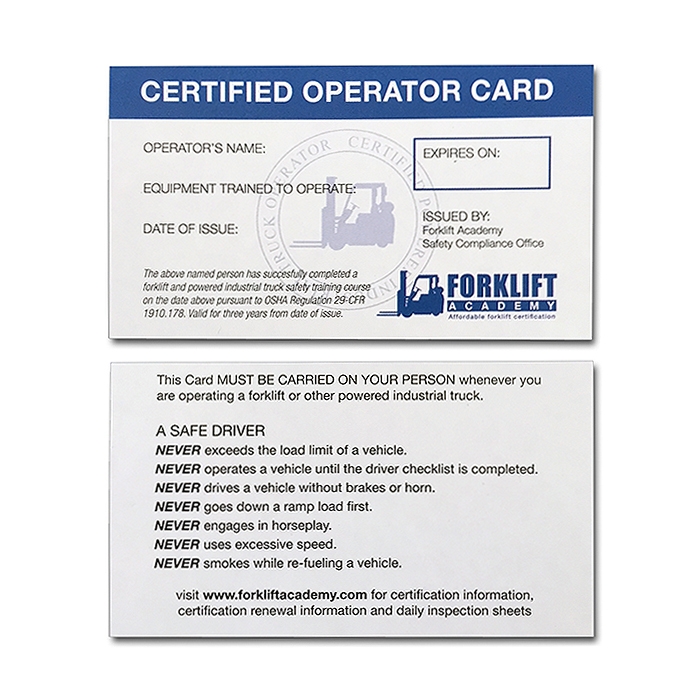
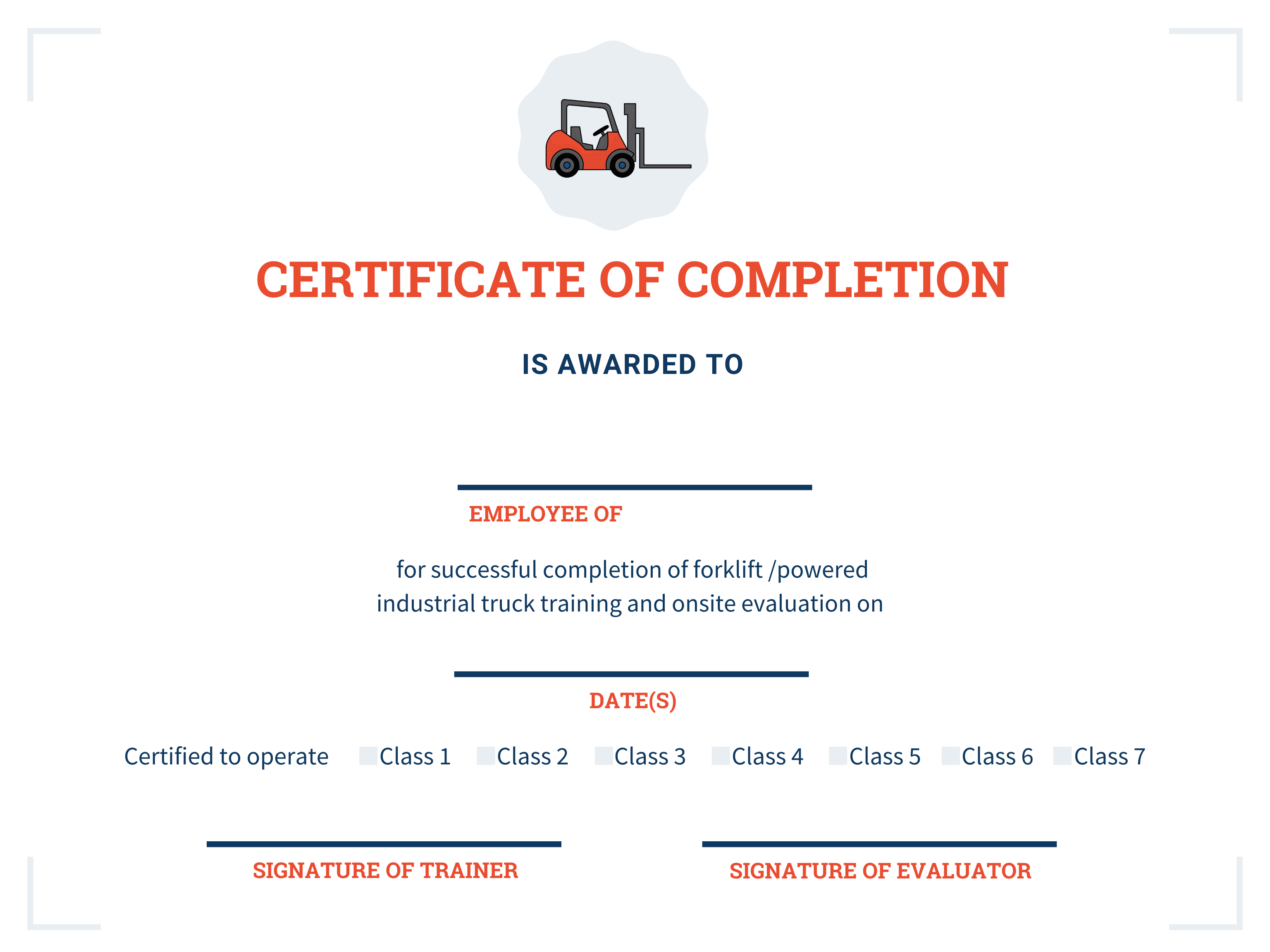
After successfully completing both the online knowledge test and the practical evaluation, you’ll officially be certified! The online provider will usually issue a certificate, often available for download or printing immediately. Some may also mail you a physical card, similar to a driver’s license. Keep this document safe! It’s proof of your qualification. Employers will want to see it, and you might need it for future job opportunities. This is the culmination of your online forklift certification journey.
Source : forkliftcertification.com
Choosing the Right Forklift Certification for Your Needs
Not all forklifts are created equal, and neither are the training needs. You wouldn’t train to drive a tiny electric pallet jack the same way you’d train for a massive, multi-directional behemoth, right? Understanding the different types of forklifts and the specific certifications available is key to getting the training that actually matters for your work. Don’t just grab a generic certificate if your job demands specialized skills. Let’s talk about making sure you get the right forklift certification.
Understanding Forklift Classes and Types
Forklifts, or “powered industrial trucks” as OSHA officially calls them, come in various classes. These generally fall into three main categories::
- Class I: Electric Motor Mast–Riding Forklifts: These are your standard electric forklifts, common in warehouses. Think counterbalanced forklifts.
- Class IV: Cushion Tire Forklift Trucks: Primarily for use indoors on smooth surfaces, these have solid tires.
- Class V: All Other Forklifts, Including Rough Terrain: This is a broad category that includes engine-powered forklifts (like pneumatic tire models) and specialized units designed for outdoor or uneven terrain.
Many online courses provide a general certification covering the most common types (often Classes I, IV, and V), suitable for a wide range of warehouse and industrial jobs. However, for very specialized equipment, you might need additional, targeted training. Knowing your equipment helps you select the most appropriate forklift operator training.
General vs. Specific Forklift Training Online
Most online courses offer a “general forklift operator” certification. This is usually sufficient for the majority of job roles, covering the fundamental safety principles and operating procedures applicable to most common forklift types. It satisfies the employer’s responsibility to Make sure basic competency. However, if you’ll be operating highly specialized equipment, like rough terrain forklifts, order pickers, or equipment with unique controls, you might need a more specific training program. Always check with your employer or the course provider to confirm if the general certification covers the specific forklift you’ll be using.
What About OSHA’s Specific Forklift Regulations?
OSHA’s regulations (specifically 29 CFR 1910.178) don’t dictate a single, prescribed training curriculum. Instead, they lay out the performance, knowledge, and safety standards that operators must meet. This flexibility is why online courses can be so effective. They are designed to cover the Needed knowledge areas mandated by the standard. Look for courses that explicitly reference OSHA’s requirements and demonstrate how their content aligns with those regulations. This ensures the training isn’t just a formality but a genuine effort to meet OSHA’s safety mandates.
Costs, Time Investment, and Value of Online Certification
Let’s talk brass tacks. How much does this all cost, and how much time will it really take? Getting an OSHA approved forklift certification online is generally much more affordable and faster than traditional classroom training. But the ‘value’ isn’t just about the price tag; it’s about the return on investment – getting you qualified for a better job or keeping you compliant. We’re talking about a small price for a significant career boost or a Key safety requirement. Let’s break down the financial and time commitment involved.

Source : osha.com
Typical Cost Range for Online Courses
You can find online forklift certification courses ranging from as little as $25 to upwards of $100 or more. The price often depends on the provider’s reputation, the comprehensiveness of the course, and whether any additional materials or support are included. Cheaper options might be tempting, but always check their legitimacy and reviews. Investing a bit more in a well-regarded provider often means better training, more reliable certification, and peace of mind. Remember, you’re paying for knowledge and compliance, not just a piece of paper. Consider the value of a recognized forklift certification.
Time Commitment: How Long Does It Actually Take?
The time it takes to complete an online course can vary. Most programs are designed to be finished within a few hours – perhaps 2 to 4 hours of dedicated study time. However, this is flexible. Since you can often go at your own pace, you might spread it out over a few days or complete it in one sitting if you have the time and focus. The Key point is that the course needs to be thorough enough to cover all necessary topics, regardless of how quickly you can speed through it. Don’t rush the learning part; Make sure you understand everything for your forklift operator exam.
The ROI: Why Certification is Worth the Investment
Jobs you can apply for once you’re certified. Many positions in warehousing, manufacturing, construction, and logistics require forklift certification. Without it, you’re simply not considered. Getting certified opens doors that would otherwise remain shut. Even if you already have a job, proper certification can lead to better pay, more responsibilities, and improved safety, reducing the risk of accidents. The relatively low cost and short time investment make online forklift certification an incredibly high-value proposition for your career.
Sample Data: Online Forklift Certification Course Comparison
Choosing the right provider can feel overwhelming. To help you visualize the differences, here’s a look at some hypothetical (but realistic) offerings. Remember to always verify current details directly with providers!
| Feature | Provider A (Budget Focus) | Provider B (Full) | Provider C (Industry Specialist) |
|---|---|---|---|
| Price Range | $25 – $45 | $59 – $89 | $75 – $120 |
| Est. Time to Complete | 2-3 hours | 3-5 hours | 4-6 hours (with specialized modules) |
| OSHA Compliance Claim | Yes, meets OSHA standards | Yes, exceeds OSHA requirements | Yes, specific to OSHA 1910.178 |
| Forklift Classes Covered | General (Classes I, IV, V) | General (Classes I, IV, V) + basic electric pallet jack | General + Optional specialization (e.g., rough terrain, order picker) |
| Practical Evaluation | Requires separate arrangement (employer) | Guidance provided for employer evaluation | Detailed guide for employer evaluation; some offer virtual options for advanced users |
| Certificate Format | Downloadable PDF | Downloadable PDF + Optional Wallet Card | Downloadable PDF + Professional Wallet Card |
| Customer Support | Email support | Email & Phone support | Dedicated Support & Trainer Access |
| Retake Policy | 1-2 free retakes | Unlimited free retakes | Unlimited free retakes |
Common Misconceptions About Online Forklift Certification
You hear things, right? People say online certificates aren’t “real” or that OSHA hates them. Let’s bust some myths. The biggest mistake people make is assuming all online training is fluff. That’s just not true if you pick the right provider. You need to understand that legitimate online forklift training is designed to meet the same core requirements as in-person classes, just with more flexibility. Dismissing it outright means you might be missing out on a perfectly valid and convenient way to get qualified. Let’s clear the air on some of these common misunderstandings.
“Online Certificates Aren’t OSHA Approved”
This is the most persistent myth. As we’ve discussed, OSHA sets the standards for training, but doesn’t approve specific courses. Employers are responsible for ensuring their operators are trained by a qualified source. Reputable online providers offer training that meets or exceeds these OSHA standards. An employer who understands OSHA regulations will recognize a Full online course as a valid way to fulfill their training obligation. The key is the content and quality of the training, not just the delivery method. Focus on providers who clearly state their compliance with OSHA’s training mandate.
Source : forkliftacademy.com
“You Can’t Learn Forklift Operation Just From a Computer”
This one has a grain of truth, but misses the full picture. Online courses provide the formal instruction part of the requirement – the knowledge, the safety rules, the hazard identification. OSHA explicitly allows for this type of learning. The practical, hands-on operation and evaluation component is usually handled separately, often by the employer. So, the online course Provides you with the necessary knowledge, and the practical session (which is always required, online or not) confirms your ability to apply it. It’s a blended approach that works effectively for delivering forklift safety training.
“All Online Forklift Courses Are Cheap Scams”
Okay, sure, there are probably some sketchy websites out there offering worthless certificates for $10. But that doesn’t mean the entire category is a scam. Many established and trusted organizations offer excellent online forklift certification programs. These providers invest in quality content, user-friendly platforms, and Strong customer support. They understand the importance of genuine training for safety and compliance. Always do your due diligence – check reviews, look for clear explanations of the curriculum, and verify their claims about meeting OSHA requirements. A slightly higher price often reflects a more thorough and credible program.
Preparing for Your Practical Forklift Evaluation
You’ve aced the online knowledge test. Awesome! But don’t get too comfortable just yet. The practical evaluation is where you show you can actually do the job safely. This isn’t just about knowing the rules; it’s about applying them. Whether it’s your employer evaluating you or someone you’ve arranged, being prepared is key. You need to demonstrate not just proficiency, but a commitment to safety. This hands-on part is critical for your forklift certification validity. Let’s make sure you knock this part out of the park.
What to Expect During the Hands-On Assessment
The evaluation typically involves a few key components. First, a pre-operation inspection of the forklift. You’ll need to check tires, forks, controls, fluids, lights, and safety devices. Think of it like a pilot’s pre-flight checklist. Next, you’ll likely be asked to operate the forklift in a controlled environment. This could include driving forwards and backward, turning, picking up and placing loads at various heights, maneuvering in tight spaces, and perhaps even performing basic ramp operations. The evaluator will be watching your control, awareness of surroundings, and adherence to safety procedures throughout. They’re looking for consistent safe forklift operation.
Tips for Demonstrating Safe Forklift Operation
Here are some pointers to make sure you shine during your practical test:
- Know Your Machine: Be familiar with the specific forklift you’ll be using. Understand its controls, limits, and any unique features.
- Pre-Operation Checks: Perform a thorough inspection. Point out any potential issues, even minor ones. This shows diligence.
- Situational Awareness: Constantly scan your surroundings. Be aware of pedestrians, other equipment, overhead obstructions, and floor conditions.
- Smooth Control: Operate smoothly. Avoid jerky movements. Accelerate, brake, and steer gently.
- Proper Load Handling: Make sure the load is centered and stable on the forks before lifting. Lift and lower loads smoothly. Never travel with elevated forks unless necessary.
- Safe Travel: Keep forks low when traveling. Maintain a clear view. Use a spotter if visibility is poor. Sound the horn at blind corners or intersections.
- Follow Instructions: Listen carefully to the evaluator’s instructions and perform tasks as directed.
Demonstrating these habits consistently proves you’re ready for real-world forklift use.
What If You Don’t Have Access to a Forklift for Practice?
This is a common hurdle, especially if you’re seeking certification independently. The best approach is to coordinate with potential employers. Explain that you’ve completed your online training and are seeking a company that can provide the required practical evaluation. Many companies are willing to offer this if they see you’ve already invested in the theoretical part of your training. Alternatively, some specialized training centers might offer practical sessions for a fee. Never try to skip this step; it’s a mandatory part of ensuring you get truly OSHA compliant certification.
Source : safesitehq.com
Maintaining Your Forklift Certification
Think getting certified is the end of the road? Think again. While OSHA doesn’t set a universal expiration date for forklift certifications (it depends on the employer and specific regulations), regular refreshers and ongoing training are highly recommended, and often required. Workplace conditions change, new equipment is introduced, and safety practices evolve. Staying sharp is Key for maintaining your qualifications and, more importantly, ensuring your safety and the safety of those around you. Keeping your forklift operator certification current is Key.
OSHA’s Requirements for Refresher Training
OSHA mandates that operators be evaluated at least once every three years. This evaluation needs to confirm that they are still competent in operating powered industrial trucks safely. Employers must also provide additional training if they observe the operator working in an unsafe manner, if the operator is involved in an accident or near-miss incident, if they are assigned a different type of truck, or if changes in the workplace render previous training obsolete. So, while your initial certificate might not have an expiration date, this periodic re-evaluation is effectively a form of certification renewal.
When to Seek Additional or Specialized Training
Beyond the mandatory evaluations, consider additional training when:
- You’re assigned to operate a forklift class or type you haven’t used before.
- Your workplace introduces new safety procedures or equipment.
- You move to a different industry with unique operational challenges (e.g., cold storage, hazardous materials).
- You want to improve your skills or advance your career by becoming an instructor or supervisor.
Continuous learning is the hallmark of a true professional. Investing in ongoing forklift skills development keeps you valuable and safe.
Keeping Records of Your Training and Certifications
It’s your responsibility to keep track of your training records. This includes your initial online course completion certificate, details of any practical evaluations, and records of refresher training. When applying for jobs, employers will likely ask for proof of your certification. Having these documents readily available makes the hiring process smoother. Some online providers offer a portal where you can access your certificates anytime, which is a handy feature to look for. Maintaining organized records is a professional practice for anyone holding a certified forklift operator credential.
Frequently Asked Questions
How to get OSHA certified forklift license?
To get your OSHA forklift certification, you gotta complete an accredited training program. A lot of places offer these online now, which is super convenient. You’ll typically do some online coursework and then maybe a practical assessment, depending on the provider. Once you pass, you get your certificate!
How long does online OSHA forklift certification take?
Because it’s online, it’s pretty flexible. Most courses can be finished in a few hours, like maybe 2 to 4 hours, but it really depends on how fast you go and the specific program. Some people knock it out in an afternoon. The important thing is you actually learn the stuff, not just speed through it. Get your forklift certification quickly but properly.
Is OSHA online forklift training legit?
Yeah, it totally is, as long as the training provider is accredited and follows OSHA’s guidelines. It’s not some shady operation. Employers recognize these certificates because the training covers all the necessary safety standards. Just make sure you’re looking at a reputable online source for your OSHA forklift training.
Can I get my OSHA certificate online?
Absolutely! That’s the beauty of it. You can complete the entire classroom portion of your OSHA forklift certification online. You’ll learn all the safety rules and operational procedures. Depending on the training, you might need to do a practical evaluation afterward, but the bulk of the learning is accessible from your couch.
What are the requirements for online forklift certification?
But basically, you need to be at least 18 years old and have a valid form of identification. For the online part, you just need a computer or tablet with internet access. Some programs might require you to have a way to do a practical demonstration later to complete your forklift license, so check with the provider.
