Moon Phases Calendar For 2026
The 2026 Moon Phases Calendar: What You Need to Know
Alright, let’s talk about the moon. Seriously. You think you know it, right? It’s just that big ol’ rock in the sky. But have you ever actually looked at a moon phases calendar? It’s more than just pretty pictures. It’s a whole celestial dance, and 2026 is lining up to be a showstopper. We’re talking about the predictable, yet always awe-inspiring, journey the moon takes around our Earth. And knowing when these phases hit can be surprisingly useful, whether you’re a farmer, a photographer, a fisherman, or just someone who likes to gaze upwards with a bit more knowledge. Forget those generic calendars; we’re diving deep into the lunar cycles of 2026.

Source : amazon.com
Look, I get it. In our busy lives, the moon often takes a backseat. We’re glued to screens, rushing from A to B. But the moon? It’s been doing its thing for billions of years. It dictates tides, influences wildlife, and has inspired poets and lovers forever. So, let’s shed some light on exactly what’s happening in the sky next year. We’ll break down the key dates, explain what those different phases actually mean (no, it’s not just full and new!), and give you the lowdown on any special celestial events. Get ready to mark your own 2026 moon calendar because this is the stuff you won’t find in your average wall plaer.
Decoding the Lunar Cycle: It’s Not Just Full or New
So, what exactly are moon phases? It’s basically how much of the sunlit side of the moon we can see from Earth. It’s not the moon changing shape, obviously. It’s about perspective. As the moon orbits us, the angle between the Earth, Moon, and Sun shifts. This changing illumination is what creates the cycle. You’ve got the obvious players: the New Moon, when the moon is between us and the sun and basically invisible, and the Full Moon, when Earth is between the sun and moon, lighting it up like a disco ball. But there’s a whole lot more going on in between. Think of it as a slow, consistent transformation.
Between the New Moon and the Full Moon, we see the moon get progressively bigger in the sky. This is the waxing period. First, it’s a sliver – the Waxing Crescent. Then, it looks like half the moon is lit up – that’s the First Quarter. After that, it’s more than half lit but not quite full – the Waxing Gibbous. Then BAM! Full Moon. After the Full Moon, it starts to shrink from our perspective. This is the waning period. It goes from a Waning Gibbous (still mostly lit, but shrinking) to the Last Quarter (half lit again, but on the other side), then the Waning Crescent (just a sliver before the cycle restarts with the New Moon). It’s a beautiful, predictable rhythm. Understanding these stages is key to appreciating the moon’s journey.
Your Essential 2026 Moon Phases Calendar
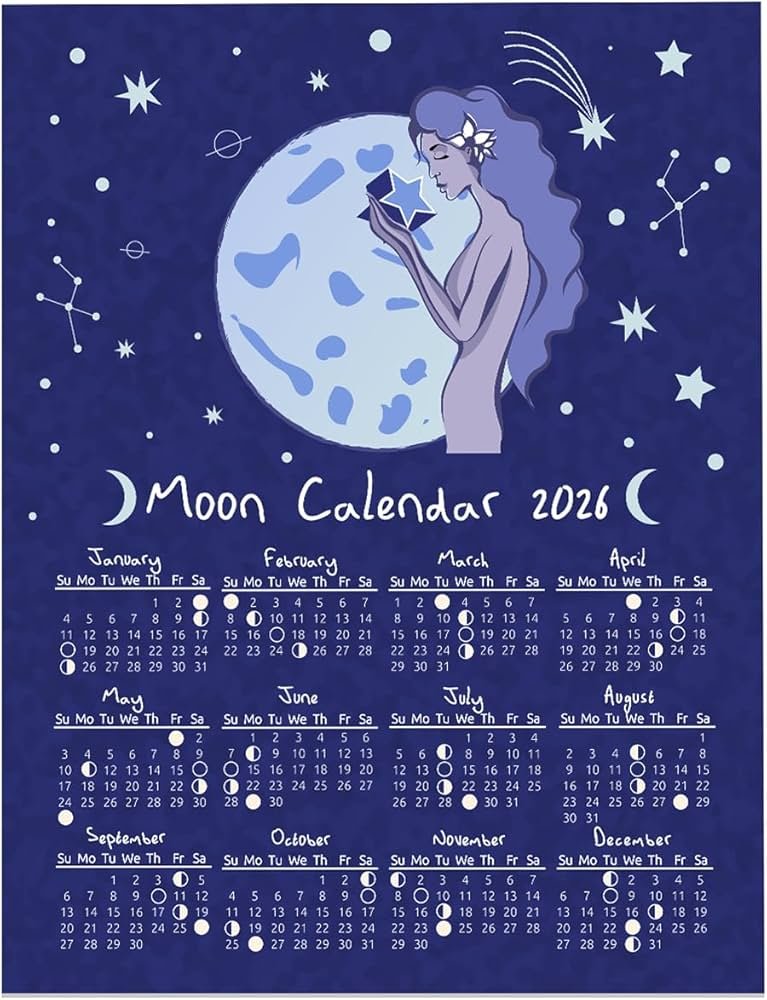
Let’s cut to the chase. You want the dates. You want to know when to look up. Here’s the breakdown for the key moon phases in 2026. Remember, these are approximate times and can vary slightly based on your exact time zone. For precise times, always check a reliable source like timeanddate.com.

Source : amazon.com
January 2026: A Fresh Start Under the Lunar Glow
We kick off 2026 with a bang. The year starts right after a Full Moon on December 29th, 2025. So, January begins in the Waning Gibbous phase. Expect the Last Quarter moon to hit around January 5th. Then, the New Moon arrives on January 13th, marking the true start of the lunar cycle for the year. The First Quarter moon will shine on January 20th, and we’ll finish the month with a Waxing Gibbous, heading towards February’s Full Moon. This is a great time for starting new projects, aligned with the New Moon energy.
February 2026: The Winter Sky’s Luminary
February keeps the cycle moving. We start with that Waxing Gibbous from January. The Full Moon – known traditionally as the Snow Moon – graces us on February 12th. This is a prime date for stargazing if you’re in a place with clear winter skies. Following this, we move into the waning phases. You’ll see the Last Quarter moon around February 19th. The New Moon arrives on February 27th, giving us a dark sky perfect for observing fainter celestial objects. February’s cycle is a classic example of the moon’s consistent orbit.
March 2026: Spring Equinox and Lunar Light
As spring begins to peek through, March offers its own lunar magic. The cycle starts with the New Moon from late February. The First Quarter moon pops up around March 6th. Then, on March 14th, we have the Full Moon, traditionally called the Worm Moon. This Full Moon often coincides closely with the spring equinox, making it a significant time for many cultures. Following this lunar peak, the moon begins to wane, with the Last Quarter appearing around March 21st. The New Moon wraps up the month on March 29th, setting the stage for April. This period highlights the lunar influence on seasonal changes.
April 2026: The Pink Moon and Easter Skies
April’s Full Moon, the so-called Pink Moon, occurs on April 12th. Despite the name, it’s not actually pink! It gets its name from the early blooming wildflowers that appear around this time. This Full Moon is a real visual treat. Before that, the cycle includes the Waning Gibbous from March’s Full Moon, the Last Quarter on March 21st, and the New Moon on March 29th. After the April 12th Full Moon, we’ll see the First Quarter moon on April 20th. The month ends with a Waxing Gibbous, leading us into May. It’s a beautiful lunar event.
May 2026: Flower Moon and Early Summer Nights
May brings the Flower Moon to its peak on May 12th. As the name suggests, flowers are in full bloom, and the nights are getting longer and warmer – perfect for moonlit strolls. We start May in a Waxing Gibbous phase. After the Full Moon on the 12th, the moon begins its descent. The Last Quarter moon phase occurs around May 19th. Then, the New Moon arrives on May 27th, plunging the night sky into darkness ideal for meteor showers or deep-sky observation. The celestial dance continues, showcasing the predictable phases.
June 2026: Strawberry Moon and Summer Solstice
June’s Full Moon, the Strawberry Moon, arrives on June 10th. It’s named after the short season for harvesting strawberries in the northeastern United States. This Full Moon happens just a few days before the summer solstice, making it the last Full Moon of spring in the Northern Hemisphere. The month kicks off with the New Moon from late May. The First Quarter moon phase is visible around June 17th. Following the Strawberry Moon, we move towards the Last Quarter around June 19th. The New Moon on June 26th sets up the next cycle. This month is packed with significant celestial timing.
July 2026: Buck Moon and Midsummer Nights
July’s Full Moon, the Buck Moon, peaks on July 9th. This Full Moon often occurs when the male deer, or bucks, start growing their new antlers. It’s a time of growth and abundance. We begin July in a Waning Gibbous phase. The Last Quarter moon appears around July 19th. The New Moon follows on July 26th, offering a dark canvas for the night sky. The cycle then restarts with the First Quarter moon phase appearing around July 17th. This month shows the moon’s steady progression.

Source : reddit.com
August 2026: Sturgeon Moon and Peak Summer
August brings us the Sturgeon Moon on August 7th. Native American tribes used this name because fishing tribes found sturgeon abundant during this time. This Full Moon is also a Supermoon – when a Full Moon coincides with its closest approach to Earth in its orbit, making it appear larger and brighter. We start August in a Waxing Gibbous phase. The Last Quarter moon is visible around August 17th. Then, the New Moon arrives on August 24th. The First Quarter moon will be seen around August 15th. This Supermoon is a highlight of the year.
September 2026: Harvest Moon and Autumn Equinox
September hosts the Harvest Moon on September 6th. This is the Full Moon closest to the autumn equinox, and it traditionally rises only about 30 minutes later each night for several nights around the full moon, allowing farmers to work late into the night. It’s a truly magical time. The month begins with the New Moon from late August. The First Quarter moon phase occurs around September 14th. After the Harvest Moon, the moon wanes, with the Last Quarter appearing around September 23rd. The New Moon wraps up the month on September 22nd. This marks the start of autumn.
October 2026: Hunter’s Moon and Crisp Autumn Nights
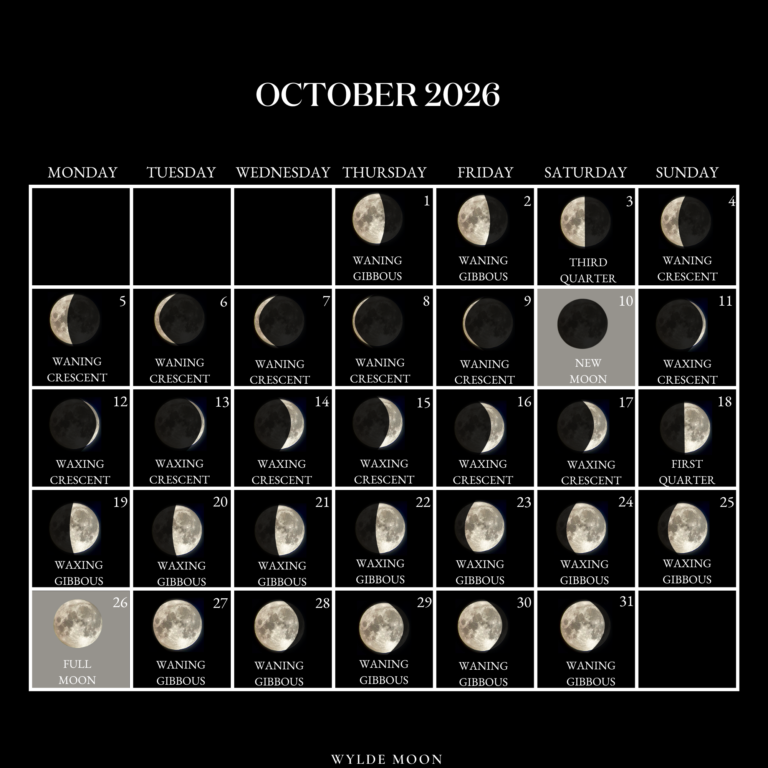
October brings the Hunter’s Moon on October 6th. This is the Full Moon that follows the Harvest Moon. Native Americans called it the Hunter’s Moon because it was the time to hunt and store meat for the coming winter. We begin October in a Waning Gibbous phase. The Last Quarter moon is visible around October 22nd. The New Moon arrives on October 21st, marking another cycle. The First Quarter moon will be seen around October 14th. This is a classic autumn moon.
November 2026: Beaver Moon and Late Autumn
November’s Full Moon, the Beaver Moon, occurs on November 5th. Traditionally, this is the time when beavers began to prepare their winter dens, and when colonists trapped beavers. It’s a chilly moon for a chilly time of year. The month starts with the New Moon from late October. The First Quarter moon phase is visible around November 13th. After the Beaver Moon, the moon wanes, with the Last Quarter appearing around November 29th. The New Moon wraps up the month on November 20th, setting the stage for December. It’s a memorable lunar event.
December 2026: Cold Moon and Year’s End
We close out 2026 with the Cold Moon on December 5th. Named for the long, cold nights of winter, this Full Moon is the last one of the year. The month begins with the New Moon from late November. The First Quarter moon phase occurs around December 13th. Following the Cold Moon, we move into the waning phases, with the Last Quarter around December 29th. The New Moon on December 20th marks the final lunar event of 2026, and the cycle begins anew. This is the final full moon of the year.
Beyond the Basics: Special Lunar Events in 2026
While the regular cycle of New, First Quarter, Full, and Last Quarter moons is fascinating enough, 2026 has a few extra tricks up its sleeve. We’ve already touched on the Supermoon in August, but let’s recap some of the other potential highlights. Keep in mind, precise timings for events like meteor showers are subject to change and depend heavily on viewing conditions. For the most up-to-date information, it’s always best to check resources like TheSkyLive or astronomical almanacs. These sites offer detailed charts and predictions for the entire year. You can find comprehensive details on lunar events for 2026 there.
One of the most talked-about events is always the Supermoon. In 2026, the August 7th Full Moon is slated to be a Supermoon. This means the moon will be at or near its closest point to Earth (perigee) when it becomes full. The visual difference can be subtle to the casual observer, but to the dedicated astronomer or photographer, it’s a significant event. It can make the moon appear up to 14% larger and 30% brighter than a micromoon (a Full Moon at apogee, its furthest point). It’s a great excuse to get out and appreciate our celestial neighbor. Don’t miss this bright lunar spectacle.

Source : firstprintable.com
While 2026 doesn’t appear to have any total lunar eclipses visible from most populated areas (though partial or penumbral eclipses might occur and be viewable in specific regions), there are still other phenomena worth noting. Sometimes, planets like Jupiter or Saturn can appear very close to the Full Moon in the sky, creating stuing conjunctions. These aren’t official ‘moon events’ but offer fantastic photographic opportunities. Always check your local astronomical society listings for any specific planetary alignments or less common phenomena. Tracking these events can add another layer of excitement to your night sky observations.
Why Tracking Moon Phases Matters
Okay, so you have the dates. But why bother? Why track the moon phases calendar for 2026? Well, it goes deeper than just knowing when to expect a bright night sky. For centuries, human activities have been tied to the lunar cycle. Farmers have long planted crops based on the moon’s phases, believing certain times yield better growth. While modern science debates the extent of this influence, the tradition persists. It’s about working with nature’s rhythms, not against them. Understanding these cycles coects you to an older way of living. It’s a bit of ancient wisdom meeting modern life.
Beyond agriculture, the moon’s phases are crucial for activities like fishing and hunting. Certain fish species are more active during specific moon phases, particularly around the Full Moon and New Moon. Likewise, nocturnal hunting can be influenced by the amount of moonlight available. Even for something as simple as stargazing, knowing the moon phase is critical. A bright Full Moon can wash out fainter objects like nebulae and distant galaxies. If you want to see the Milky Way or catch a meteor shower, you’ll want to plan your observations for the nights surrounding the New Moon. It’s all about timing your experience.
And then there’s the sheer wonder of it all. There’s something deeply grounding about witnessing the moon wax and wane. It’s a constant, reliable cycle in a world that often feels chaotic. It reminds us of the vastness of the universe and our small place within it. Whether you’re using the moon phase to plan a romantic picnic, a night of astrophotography, or just to feel more coected to the natural world, having a 2026 moon calendar is your first step. It’s a simple tool that opens up a universe of possibilities, coecting you to something ancient and profound. So, go ahead, download one, print it out, stick it on your fridge. Let the moon guide you through 2026.
Frequently Asked Questions About 2026 Moon Phases
What are the full moon dates for 2026?
You bet! Here are the dates for the full moons in 2026: January 12th, February 12th, March 14th, April 12th, May 12th, June 10th, July 9th, August 7th (a Supermoon!), September 6th, October 6th, November 5th, and December 5th. Mark your calendars!
How many types of moons are coming in 2026?
Great question! In 2026, you’ll see all the main phases: the New Moon, Waxing Crescent, First Quarter, Waxing Gibbous, Full Moon, Waning Gibbous, Last Quarter, and Waning Crescent. Plus, we’ve got a special Supermoon in August! So, quite a variety.
Is there a pink moon in 2026?
Yes, there is! The Pink Moon in 2026 falls on April 12th. Don’t expect it to actually be pink, though. It gets its name from the wildflowers that bloom around this time. Still a beautiful sight!
When is the Harvest Moon in 2026?
The Harvest Moon, the Full Moon closest to the autumn equinox, will shine on September 6th, 2026. It’s famous for rising around the same time each night, making fields easier to harvest by moonlight.
What is a Supermoon and when is it in 2026?
A Supermoon happens when a Full Moon occurs near its closest point to Earth, making it appear bigger and brighter. In 2026, the Supermoon is scheduled for August 7th. It’s a fantastic night for stargazing and appreciating the moon’s grandeur.