Epic Proficiency vs. Certification: How Long Does It Take?
Look, let’s cut the jargon. You’re probably staring at your screen, wondering how long this whole Epic certification thing is going to take. Maybe you’re eyeing a new job, maybe you’re trying to level up at your current gig. Whatever the reason, the burning question is always time. And money. But mostly, time. Because time is money, right? Especially in this healthcare IT game.
We hear it all the time: “Is it proficiency?” “Is it certification?” What’s the difference? And more importantly, how many caffeine-fueled days and sleepless nights are we actually talking about here? It’s not a simple yes or no, that’s for sure. It’s a winding road, and the destination looks a little different depending on which path you take.
The Real Deal: What Even IS Epic Proficiency?

Source : healthcareitskills.com
Forget the fancy brochures for a second. Epic proficiency is about getting your hands dirty. It’s the grit, the day-to-day grind of actually using the system. Think of it like learning to drive a car. Proficiency isn’t about passing a written test; it’s about parallel parking without hitting the curb, every single time. You learn by doing, by making mistakes (hopefully minor ones!), and by becoming that person who just knows where everything is.
Daily Operations Mastery
This is the bread and butter. Can you navigate the patient charts like a seasoned pro? Do you know the shortcuts to open the right screens faster than you can say “HL7”? Proficiency means you’re not fumbling around, clicking through menus like a lost tourist. You’re efficient. You’re getting the job done.
This level of skill typically comes from working with the system daily. You’re not just logging in; you’re actively managing schedules, documenting encounters, or processing orders. It’s the kind of learning that happens organically, day in and day out, often within your specific role.
Role-Specific Skill Development
Your proficiency as a scheduler will look wildly different from a nurse’s or a billing specialist’s. It’s tailored. You’re not expected to know the ins and outs of every single module Epic offers. Proficiency focuses on the tools and functions directly relevant to your job description. It’s about doing your job well within the Epic environment.
So, the time it takes? It varies wildly. Some folks pick it up in weeks. Others, struggling with the complexity or lack of formal training, might take months. It’s less about a clock ticking and more about hands-on experience accumulating.
The “Seat Time” Factor
A huge part of gaining proficiency is simply “seat time.” How many hours are you actually logged into the system, performing tasks? More hours usually means faster development. It’s almost intuitive. The more you do something, the better you get at it. Gaining proficiency isn’t a formal course; it’s a byproduct of consistent work.
This is where the “how long” question gets fuzzy. Someone working full-time in a busy clinic might achieve deep proficiency in six months. Someone on a part-time schedule or in a role with less system interaction might take a year or more. There’s no official “proficiency certificate” because it’s so tied to individual experience.
Certification: The Formal Stamp of Approval
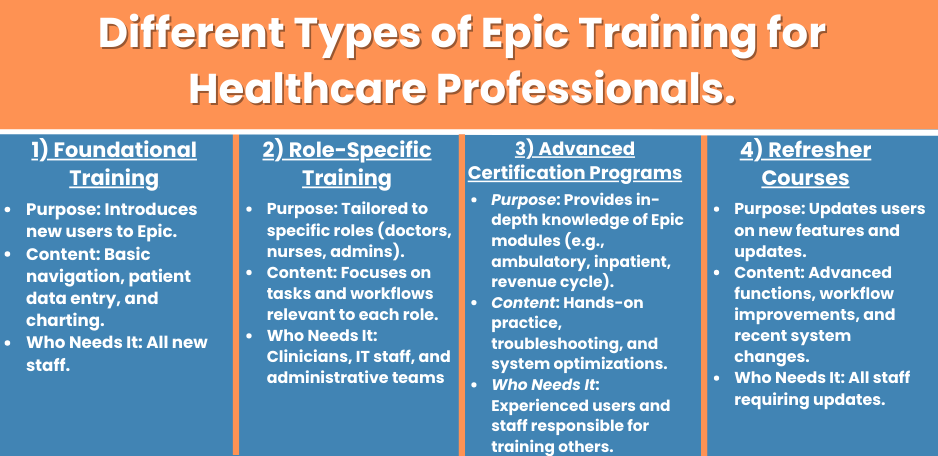
Now, let’s talk about certification. This is the official stuff. The thing you put on your resume that makes recruiters perk up. It’s a formal credential, usually obtained by passing a rigorous exam. It signifies a deep, broad understanding of a specific Epic module or application. Think of it as earning a black belt in martial arts, not just knowing how to throw a punch.
Source : virtelligence.com
Unlike proficiency, which is about practical, day-to-day use, certification is about demonstrating Full knowledge. It’s often required for specific roles, especially those involving training, implementation, or specialized support. It’s a commitment.
The Official Epic Curriculum
To get certified, you don’t just wing it. Epic has a structured curriculum. This involves formal training sessions, often conducted by certified instructors. These aren’t casual workshops; they’re intensive courses designed to cover the application inside and out. You’ll be studying policies, procedures, and functionalities that might be beyond your daily job needs.
The length of these formal training courses can vary significantly. Some might be a few days; others can stretch over several weeks. This depends heavily on the specific module you’re training for. Building this foundational knowledge is the first formal step toward the certification exam.
Passing the Rigorous Exam
Here’s the kicker: the exam. It’s not a multiple-choice quiz you can cram for the night before. Epic certification exams are notoriously tough. They test your ability to apply knowledge, troubleshoot common issues, and understand the underlying logic of the application. You might face scenario-based questions or even practical demonstrations.
Passing this exam is the gatekeeper to official certification. Many people go through the training but don’t pass on the first try. It requires serious dedication and a thorough grasp of the material. The difficulty of certification is a major factor in its perceived value.
Time Investment for Certification
So, how long does this take? The formal training itself might be anywhere from a week to a month, depending on the module. But that’s just the classroom time. Factor in the studying, the practice, the potential retakes of the exam, and you’re looking at a significant time commitment. Most estimates put the journey from starting training to achieving certification at anywhere from three to six months, assuming you pass.
This often includes dedicated study time outside of the formal training hours. It’s not uncommon for individuals to spend evenings and weekends poring over training materials. You can learn more about the overall process on sites like healthcareitskills.com, which details various aspects of getting Epic certified.
Proficiency vs. Certification: The Time Discrepancy
This is where the confusion often lies. Proficiency is earned. Certification is awarded. And the timelines? Dramatically different. You can be highly proficient in your role within weeks or months of starting a job. That’s the organic growth.
Certification, on the other hand, is a structured, time-bound process. It requires formal training and a high-stakes exam. It’s a deliberate pursuit, not a natural consequence of doing your job. You don’t accidentally become certified; you work towards it.
On-the-Job Learning Curve
Guy running a pizza shop on 4th Street. He learns to make pizza by making pizza. He gets proficient pretty quickly. He knows the dough, the sauce, the oven temps. That’s his daily grind. He doesn’t need a ‘pizza-making certification’ to run his business effectively. Proficiency is his currency.
Similarly, many healthcare professionals use Epic daily and become incredibly proficient without ever seeking formal certification. Their daily tasks build their skill. This kind of learning is continuous and deeply integrated into their workflow. It’s about practical application, not theoretical knowledge.
Structured Training Timelines
Certification, however, imposes a schedule. You attend classes during specific dates. You study for an exam with a defined content scope. The clock starts ticking with your enrollment in a training program. The “how long” becomes a more concrete question, tied directly to the vendor’s (Epic’s) prescribed path. It’s a marathon, not a sprint.
The time to get certified often involves a pre-certification training period, the exam itself, and potentially waiting for official results. This structured approach inherently takes longer than the informal learning that leads to proficiency. It’s a different beast entirely.
The Resume vs. The Reality
On your resume, “Epic Certified” looks sharp. It’s a universally recognized badge. But “Highly Proficient in Epic Cadence Scheduling” might be more accurate for someone who’s been doing it for five years straight. The time to achieve that deep proficiency? Likely longer in total hours spent, but less structured. You could be proficient in a specific module in less than a year, while certification demands a more concentrated effort over a similar or slightly longer period, but results in a formal credential.
The key takeaway is that deep proficiency can take years of consistent, hands-on work. But formal certification is a specific, targeted process with a more defined, albeit significant, time investment. It’s apples and oranges when comparing timelines directly without context.
Factors Influencing Time to Proficiency
So, you want to get good at Epic? How fast? Well, it’s not just about wanting it. Several things play a role. Think of it like building muscle – diet, exercise, genetics all matter. For Epic, it’s your role, the training you get, and frankly, how sharp you are.
Your Specific Role and Module
Are you the person who just clicks “accept” on a few alerts a day, or are you the one building complex order sets? Your role dictates the depth and breadth of your Epic interaction. A clinical informatics nurse will need a different, likely deeper, set of skills than a front-desk receptionist.
The specific Epic module matters too. Cadence (scheduling) might feel more intuitive initially for some than complex billing modules or the intricacies of the EpicCare platform. Proficiency in different modules takes varying amounts of time.
Source : acmso.org
Quality of On-the-Job Training
Let’s be honest. Some organizations have amazing internal training programs. Others? Not so much. If you’re thrown in the deep end with minimal guidance, your journey to proficiency will be slower and likely more frustrating. Good mentors and structured on-the-job training are gold. They accelerate learning significantly.
A solid internal trainer or a supportive team lead can shave months off the time it takes to feel truly comfortable and efficient. This informal mentorship is Key for developing practical, role-specific Epic skills.
Individual Aptitude and Learning Style
Some people just have a knack for this stuff. They pick up new software quickly. Others need more repetition. Your natural aptitude and how you best learn play a massive role. Are you a visual learner? Do you need hands-on practice? Understanding your own learning style helps you seek out the right resources.
It’s like learning a language. Some people are fluent in a year; others take five. The underlying system complexity is the same, but the learner’s interaction with it varies. Personal learning pace is a huge, often overlooked, factor in how long it takes.
Factors Influencing Time to Certification
Okay, so certification is a more defined path. But even then, it’s not entirely predictable. Think of it like planning a big trip – you know the destination, but detours happen. External factors and your own preparation can really shift the timeline.
Training Program Schedule and Structure
Epic training programs aren’t offered on-demand 24/7. They run on specific schedules. You have to enroll, wait for the class to start, and complete it within its set duration. If your organization doesn’t have an upcoming session for the module you need, you wait. This scheduling bottleneck is a major time factor.
The structure of the training itself also impacts the timeline. Some programs are condensed into a few intense weeks, while others are spread out over months. The duration of formal training directly adds to the overall time investment required.
Exam Retake Policy and Success Rate
Not everyone passes the certification exam on their first attempt. Epic’s policies typically allow for retakes, but each attempt requires more study time and adds to the overall clock. If you need multiple tries, that adds weeks or even months.
The pass rate for a specific exam also matters. Some modules are known to be harder than others. Understanding the typical success rate can give you a realistic expectation of how long the entire certification process might take for you personally. This is a critical part of calculating the total time to certification.
Employer Requirements and Support
Does your employer mandate certification for your role? Are they paying for the training and exam fees? The level of support and the urgency your employer places on your certification directly influences how quickly you pursue and complete it. If it’s a “nice-to-have,” it might drag on.
Conversely, if your job hinges on getting certified by a certain date, you’ll likely prioritize it intensely. Employer push can significantly shorten the timeline. It becomes a primary focus rather than just another item on your professional to-do list. This organizational backing is key for expedited certification.
The Average Timelines: A Realistic Look
Let’s put some numbers on this. While it’s tough to give a single, definitive answer, we can talk averages and ranges based on common experiences.
Proficiency: Weeks to Years
Getting proficient enough to do your job effectively in Epic? For most roles, this is likely in the range of 3 months to 1 year of consistent, daily use. Some might feel comfortable in as little as a month or two, especially with excellent training and a straightforward role.
Others, in more complex roles or with less structured support, might take well over a year to feel truly confident and efficient. It’s a spectrum heavily influenced by the factors we’ve discussed. This isn’t about a badge; it’s about functional competence. You’ll know when you’re proficient because the system just… works for you.
Certification: Months (Typically 3-6)
For formal certification, the typical timeline from starting formal training to passing the exam usually falls between 3 to 6 months. This assumes you’re taking a standard training course and passing the exam within a reasonable number of attempts.
This includes the time for the actual training course (which could be days to weeks), plus dedicated study time before and potentially between exam attempts. It’s a more concentrated effort than achieving general proficiency. Think of it as a project with a defined start and end goal. For those aiming for Epic certification, this timeframe is a common Standard.
Comparing the Two
So, you can achieve basic job proficiency much faster than formal certification. But deep, expert-level proficiency might take years of experience, far longer than the structured path to certification. It really depends on what you mean by “get there.” Are we talking about doing your job? Or holding a specific credential?
Here’s a simple breakdown table to visualize the difference:

Source : clindcast.com
| Level Achieved | Typical Timeframe | Nature of Achievement | Key Activities |
|---|---|---|---|
| Basic Role Proficiency | 1-3 Months | Functional Competence | Daily use, on-the-job training, shadowing |
| Advanced Role Proficiency | 6 Months – 2 Years | High Efficiency & Problem Solving | Complex tasks, troubleshooting, extended system use |
| Formal Certification | 3-6 Months (Concentrated) | Official Credential | Structured training course, passing a formal exam |
| Expert-Level Mastery (Years) | 2+ Years | Deep System Understanding & Influence | Implementation, optimization, advanced support, extensive experience |
Is Certification Always Necessary?
This is the million-dollar question, isn’t it? Does every single person who touches Epic need that formal certificate? My take? Absolutely not. For many roles, deep proficiency is more than enough. In fact, sometimes it’s better.
When Proficiency Shines Brighter
If you’re a nurse documenting patient care, a scheduler managing appointments, or a billing specialist processing claims, your value lies in your ability to do those tasks accurately and efficiently every day. You need to know your specific workflows inside and out. That’s proficiency. Over-focusing on a certification that covers modules you rarely touch might even be a distraction.
It: would you rather have a surgeon who passed a general surgery exam years ago and hasn’t operated since, or one who is in the OR daily, honing their skills? For many clinical and operational roles, daily practical skills trump a dated certificate.
Roles Demanding Certification
However, there are definitely times when certification is non-negotiable. Implementation teams? People training new hires? Analysts specializing in a specific Epic application (like Guide for oncology or Cupid for cardiology)? These roles often require the formal validation that certification provides. It signals a standardized level of expertise that employers rely on.
If you’re looking to break into healthcare IT implementation or move into a dedicated Epic analyst role, getting certified is usually a prerequisite. It’s the industry standard for those specific career paths. This formal recognition is often part of the job requirements for specialized Epic roles.
The Cost-Benefit Analysis
It’s a cost-benefit thing. Certification takes time, effort, and sometimes money (if your employer doesn’t cover it). Does the potential salary increase or job opportunity outweigh that investment? For some, yes, dramatically. For others, the time spent deepening their proficiency in their current role might yield better results. You need to weigh the specific demands of your career goals against the investment required for obtaining Epic certification.
Consider your career trajectory. Are you aiming for a niche technical role? Certification might be your ticket. Are you focused on excelling in your current clinical or administrative position? Deepening your proficiency might be the smarter, more direct path to success and job satisfaction.
Can You Get Certified Without Working for an Epic Healthcare Organization?
This is a common question, and the answer is… complicated, but generally leaning towards “no,” or at least, “not easily.” Traditionally, Epic tightly controls who gets access to their formal certification training. They historically favored training individuals employed by their customer healthcare organizations.
The Traditional Path: Employment First
The standard route involves being hired by a hospital system, clinic, or other healthcare entity that uses Epic. Once employed, your employer can enroll you in the relevant Epic certification training programs. This is how most people achieve certification. They get the job, then they get the training.
This model ensures that trainees are working within the environment where the skills will be applied, making the training immediately relevant. It also provides a structure for assessing proficiency and readiness for the certification exams. This is the bedrock of earning Epic credentials.
Third-Party Training and Its Limits
While there are third-party companies and individuals who offer Epic training, it’s Key to understand what they provide. They might offer valuable workshops or courses that can help you prepare for certification or gain proficiency. However, these courses often don’t grant you direct access to the official Epic-administered certification exams.
Epic itself maintains strict control over the official curriculum and testing platforms. Without that official pathway, any training, while potentially useful for knowledge acquisition, won’t result in an official Epic certification. You can gain significant knowledge, but not the official Epic certification status.
The Bottom Line on Access
So, can you get certified independently? It’s rare and difficult. You’d essentially need a healthcare organization willing to sponsor you, even if you’re not a full-time employee (like a contractor). Focusing on gaining proficiency first, then seeking roles that offer certification pathways, is usually the most practical approach. Trying to bypass the system is often a dead end for official certification.
Your best bet is to look for jobs that explicitly mention Epic training or certification as part of the onboarding process. This is where you’ll find the most direct and legitimate path to becoming an officially certified Epic professional. Many job boards list opportunities for Epic certified professionals.
Tips for Accelerating Your Epic Journey
Whether you’re aiming for proficiency or full-blown certification, you don’t have to just wait for time to pass. You can actively speed things up. Think of it as optimizing your training montage.
Immerse Yourself: Practice Makes Perfect
The single biggest accelerator? Usage. Log in. Click around. Do the tasks. Volunteer for projects that involve Epic. The more time you spend actively using the system, the faster you’ll learn. Don’t just stick to your basic tasks if you can help it; explore adjacent functionalities.
If you’re in training, review your materials before and after sessions. Don’t wait for the instructor to explain everything. Come with questions. Being proactive drastically speeds up comprehension and retention, leading to faster proficiency development.

Source : blog.thehcigroup.com
Seek Out Mentors and Resources
Find experienced colleagues who are wizards with Epic. Ask questions. Learn their shortcuts. See if your organization has internal super-users or a dedicated training department. Tap into those resources! Sometimes a quick chat with an expert can clear up confusion that hours of self-study couldn’t.
Use online forums, knowledge bases, and any official documentation available. While third-party courses might not grant certification, they can offer valuable insights and supplementary learning materials. Combining various resources accelerates your understanding of Epic functionalities.
Structured Study for Certification
If certification is your goal, treat it like a serious academic pursuit. Create a study schedule. Focus on understanding the ‘why’ behind functionalities, not just the ‘how.’ Practice exam questions religiously. Understand the exam format and common question types.
Don’t just memorize steps; learn the logic. This deeper understanding is what separates those who pass from those who don’t. It transforms the learning from rote memorization into true knowledge acquisition, Needed for passing certification exams.
The Verdict: Time is Relative, Effort is Absolute
So, how long does it take? The truth is, it depends entirely on your goals and your commitment. Are you looking to simply do your job well day-to-day? Proficiency might be achieved in months. Are you aiming for that coveted certification credential? Budget several months of focused effort.
But no matter the path, the common denominator is effort. You won’t stumble into deep proficiency or pass a tough certification exam by accident. It requires dedication, consistent practice, and a willingness to learn. The time invested is directly proportional to the skill and credential you ultimately achieve.
Choosing Your Path Wisely
Understand what your career goals are. Does your desired role require formal certification, or will deep, demonstrable proficiency suffice? Making the right choice upfront saves you time and energy. Don’t chase a certification just because it sounds good if it doesn’t Match with your actual career aspirations.
Both proficiency and certification are valuable. They just serve different purposes and require different timelines and approaches. Choose the path that best suits your needs. Remember, deep proficiency gained over years can be just as, if not more, valuable than a certificate earned in a few months for many healthcare IT roles.
Effort is the Constant
The timeframes we’ve discussed – weeks for basic proficiency, months for certification, years for mastery – are just estimates. Your personal drive can shorten or lengthen them. The key isn’t finding a magic shortcut; it’s about putting in the work consistently. That’s the real secret to Handling the world of Epic efficiently.
Whether you’re learning the ropes or aiming for the stars, consistent effort is the only guaranteed way to achieve your goals. It’s about showing up, putting in the hours, and mastering the system, one click at a time. The Epic system demands it.
Frequently Asked Questions
What is the difference between Epic proficiency and certified?
So, basically, Epic proficiency means you’ve mastered a specific module or workflow within the Epic system, like being a whiz at scheduling or charting. Certification, on the other hand, is a more formal recognition, usually proving you can teach or implement that proficiency to others, often with an official exam. Think of proficiency as being really good at a job, and certification as being qualified to train others on how to do that job well.
Is Epic proficiency worth IT?
Totally! Getting Epic proficient can seriously boost your career. It shows employers you’ve got the skills they need, which can lead to better job opportunities and higher pay. Plus, understanding the system deeply makes your day-to-day work so much smoother and more effective. It’s an investment in your professional growth.
How to get Epic proficiency certification?
Getting Epic certified usually involves completing specific training courses offered by Epic or authorized partners. You’ll dive deep into a particular module, learn best practices, and often pass an exam to prove your knowledge. It’s a structured process that requires dedication and study, but it’s definitely achievable with focus.
What are the typical timeframes for achieving proficiency versus certification?
Well, it really depends on the module and your prior experience. Basic Epic proficiency might take a few weeks of focused training and practice. Certification, though, often involves more in-depth training, hands-on experience, and a formal exam, which can stretch into several months. Some folks might get proficient faster, but that official certified status usually takes a bit longer to earn.
Are there different levels of Epic proficiency?
Oh yeah, absolutely! It’s not just a one-size-fits-all thing. You can have foundational proficiency, where you know the basics of a module, or advanced proficiency, where you’re practically a guru. Different roles and responsibilities within a healthcare organization will require different levels of proficiency, so it’s tailored to what you actually need to do with the system.
