Picture this: you’re sipping a cold drink on your porch, the sun blazing high, and the days stretching lazily into the night. But when does that magic truly begin in 2027? Let’s cut through the clutter—summer starts with the summer solstice, the day when the Northern Hemisphere tilts closest to the sun, gifting us the longest day and shortest night of the year.
The Exact Moment Summer Starts in 2027
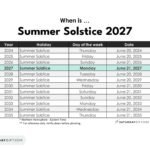
Mark your calendars for June 21, 2027. That’s when the sun reaches its highest point in the sky at solar noon, signaling the official start of summer. Though the precise timing can vary slightly depending on your time zone, this date aligns with robust astronomical data.
Key Dates and Times for the 2027 Summer Solstice
| Event | Date | Approximate Time (UTC) |
|---|---|---|
| Summer Solstice 2027 (Start of Astronomical Summer) | June 21, 2027 | 14:32 UTC |
Time may vary slightly based on exact location.

Source: smithcountyinsider.com

Source: www.theessentialcalendar.com
Why Does the Summer Start Date Change?
You might wonder why summer doesn’t always begin on the same day every year—well, it’s a mix of Earth’s orbit quirks and calendar adjustments. The summer solstice moves between June 20 and June 22 due to the elliptical orbit of Earth around the sun and leap year corrections.
- The Earth’s tilted axis means the sun’s rays hit most directly on a shifting date every year.
- Every four years, leap years tweak the calendar, nudging solstice dates slightly.
- According to the National Weather Service’s official page on astronomical seasons, these factors keep the solstice floating within these few days.
Different Ways to Define Summer’s Start
Not everyone buys into the solstice as summer’s beginning. Some swear by the meteorological seasons, which fix summer to start on June 1 every year for simplicity.
- Meteorologists like this fixed system because it aligns better with temperature cycles and forecasting.
- Farmers Almanac fans still celebrate the solstice for its rich history and astronomical significance, noting that it represents the sun’s longest day, heralding summer’s peak warmth forthcoming (Farmers’ Almanac on summer solstice).
- Some cultures have their own traditional markers for summer’s start, often tied to local climate or agricultural cycles.
What Happens on the Summer Solstice?
Think of the summer solstice as nature’s own spotlight moment. On this day, the sun’s rays blast the Northern Hemisphere with maximum intensity. This isn’t just poetic; it’s scientifically precise, creating the longest daylight of the year and the shortest night.
- Ancient civilizations like the Druids and the Mayans built monuments aligned with the solstice—like Stonehenge—showing how legendary and important the date was.
- Today, people hold festivals worldwide celebrating the light and warmth that summer promises.
- The Wikipedia entry on the summer solstice goes in-depth on cultural and scientific aspects if you want to keep exploring.
Planning Ahead for Summer 2027
If you’re planning vacations, events, or even a beach party, knowing the solstice date gives you the perfect kickoff. Expect the sun to be up for more than 15 hours in many places across the Northern Hemisphere!
Weather patterns generally start heating up in early June but that solstice day marks the peak of daylight. For outdoor enthusiasts—hikers, gardeners, or BBQ masters—the window between the solstice and the following weeks is prime time.
According to data and articles from leading sources like the Old Farmer’s Almanac on summer solstice, this day is your go-to reference for when summer officially unlocks.

Source: www.calendar.best
FAQs About When Summer Starts
When does summer start in the Northern Hemisphere in 2027?
Summer starts on June 21, 2027, marked by the summer solstice, the longest day of the year when the sun reaches its highest point.
Is June 21 always the first day of summer?
Not always—while June 21 is the typical solstice day, summer can begin as early as June 20 or as late as June 22, depending on the year due to Earth’s orbit and leap years.
What is the difference between astronomical and meteorological summer?
Astronomical summer starts with the solstice around June 20-22; meteorological summer is fixed to start on June 1 for consistent weather data and forecasting.
Does summer start earlier in the Southern Hemisphere?
Yes. In the Southern Hemisphere, summer begins at the December solstice, usually around December 21 or 22, which is their longest day of the year.
Why does the solstice date change over the years?
Because Earth’s orbit isn’t a perfect circle and because of calendar leap year adjustments, the solstice shifts between June 20 and June 22 each year.
Disclaimer: All dates and information are based on the most recently available official sources and are subject to change. Always verify with the official institution website for the most current details.

Arlen Bernier specializes in creating high-resolution digital graphics and functional planning templates. With a passion for productivity, Jay designs printable calendars that help users organize their time effortlessly.